You’ve Got the Keys. Now What?
Buildings easily outlive generations of facilities professionals. They’re frequently renovated, remodeled, repurposed and outfitted with entirely new equipment several times over.
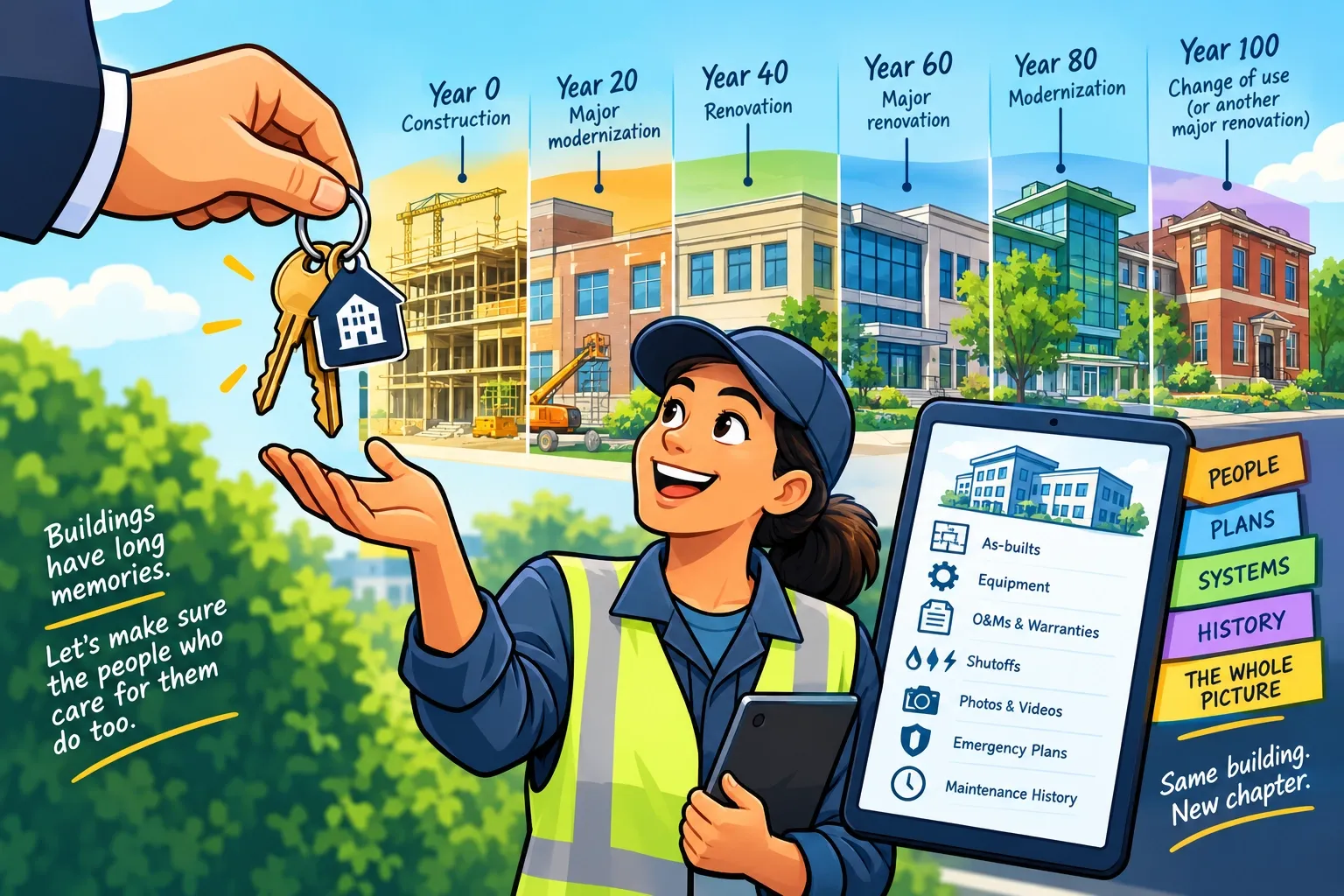
A rough conceptual model for a 100-year-old building might look something like this:
Year 0 → Construction
Year 20 → Major modernization
Year 40 → Modernization/renovation
Year 60 → Major renovation
Year 80 → Modernization/renovation
Year 100 → Another major renovation or change of use
That's potentially four or five major renovation cycles before you even count smaller projects, tenant improvements, equipment replacements and maintenance. Each project adds something to the building. And each project creates another layer of familiarity that someone must understand, maintain and eventually pass along.
So where does building knowledge live, and what happens when the current facility team takes over?
“A lot of the most important stuff is not written down,” said Leisha Lewis, Senior Facilities Manager, Canadian Mental Health Association.
“When someone is simply given the keys and told to figure it out, they wind up spending a lot of time trying to find equipment, understanding systems, and learning the building's quirks,” said Leisha.
That last part is worth thinking about. Because a building's history doesn't stop when the construction crew leaves.
“A building's useful life can extend across several generations of employees, while its operational memory may depend on a handful of individuals,” said Dean Stanberry, IFMA.
That may be one of the central problems facing facilities teams today: Buildings have long memories. People rarely do.
For facility management teams, that makes building information management more than an exercise in organizing documents. It’s about preserving what helps people understand how a building actually works.
“A technician may know a pump's specified operating range from a manual yet recognize an emerging problem from a change in sound. Another may remember that an undocumented renovation altered which spaces a particular isolation valve serves,” Dean added.
“Knowledge, like an HVAC unit, also needs maintenance. Building modifications, equipment replacements, and revised operating requirements must feed back into both records and training,” he said.
That raises a bigger question: How do organizations capture all this know how before it vanishes like a ship in the night?
The process starts with a conversation.
“We interview our staff, very vigorously at least annually, including leaders. We have a binder that holds all those results and all phases of past troubleshooting to speed up repairs and for training purposes. These topics are normally missed during the rigor of our day, which keeps many to most facilities in the reactive mode,” said Hardy Rueb, Facilities Director, Advent Health Central California Network.
It’s a fundamentally different way of thinking about facility documentation. Instead of waiting for someone to retire and hoping the important stuff made it into a file somewhere, ask the person who knows the building to explain it.
Not with a checklist of yes-or-no questions. But with detailed, open-ended questions that get into the how, why, where and what-if of operating the building.
The Facility Knowledge Capture Interview
Hardy’s Knowledge Capture Interview takes about 3-5 hours and is divided into multiple sessions to document the technical, operational and institutional knowledge team members have developed over years of working on a campus.
The sessions combine discussion, walkthroughs, demonstrations and reviews of key documents and other materials.
Interviewees explain how things work, share context and lessons learned, describe the building's quirks and identify information that could be valuable to the people who manage and operate the campus in the future.
Before the interview, they're encouraged to gather documents, drawings, photos, records and other artifacts that can help illustrate the knowledge they're sharing.
Topics covered during interviews are tailored to the employee's tenure, experience, responsibilities, and areas of specialized knowledge. For this interview, topics included:
- Roles & Responsibilities
- Door & Lock Systems
- Pneumatic Tube Systems
- Soft Water Regeneration
- General Maintenance Knowledge
- Decision-Making
- Legacy & Succession Planning
ARC Facilities can incorporate captured institutional knowledge into the building record, alongside as-builts, equipment information, O&Ms, warranties, photos, videos and other facility documentation. The goal is to give field teams useful building information from a phone, tablet or desktop rather than making them reconstruct the building's history from scratch.
Because the goal isn't simply to document a building. It's to document the memory of the building.
And then keep that memory alive.
“A building record becomes a living record when it is regularly updated to reflect what is actually in the building,” said Leisha.
That’s an important distinction. A building record shouldn’t be a snapshot of what existed when a project was completed. It should evolve as the building changes, equipment is replaced, renovations are completed and experienced people add context.
Buildings may have 100-year memories.
The people responsible for them shouldn't have to start over every time someone hands over the keys.