
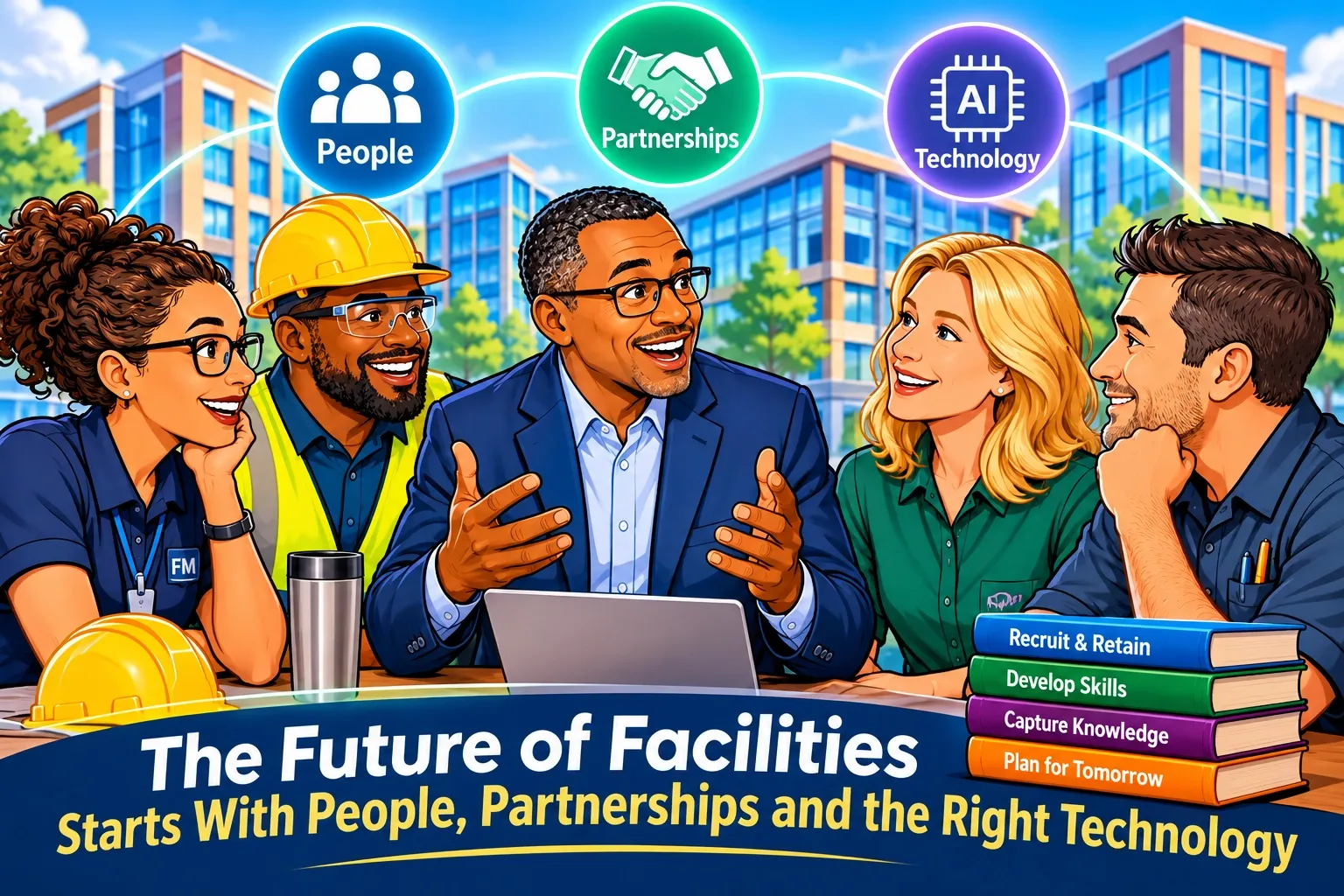
The Future of Facilities Starts With People, Partnerships and the Right Technology
The facilities workforce is changing rapidly. Skilled trade shortages, evolving technology and AI are reshaping how organizations recruit, develop and retain talent. According to Andre Allen, Chief Business Officer at HRCI, the answer isn't hiring more people and introducing more technology. It's rethinking how organizations define jobs, develop skills, capture institutional knowledge and prepare their workforce for what's coming.
In a conversation with David Trask on ARC Facilities Facility Voices podcast, Andre talked about the relationship between HR and facilities management, the changing nature of technical skills and the opportunities AI presents for facilities teams.
HR and Facilities Need to Work Together
Facilities organizations can build stronger relationships with human resources.
Typically, facilities departments approach HR when someone leaves and a position needs to be filled. The job description gets copied from the previous posting, sometimes without considering whether the qualifications still make sense.
Allen shared an example of an organization looking for an electrician. A qualified candidate was automatically rejected because the job description mistakenly required a master's degree when the actual requirement was to be a master electrician. A simple communication error eliminated a potentially excellent candidate.
Facilities leaders and HR professionals need ongoing conversations about current staffing requirements, future workforce needs and the skills necessary to succeed. That means building job descriptions around what a position actually requires rather than everything a previous employee did over 20 years.
Candidates are evaluating employers just as employers are evaluating candidates. Poor communication, confusing application processes and unanswered applications damage an organization's reputation.
Durable Skills
As technology and job responsibilities evolve, Allen believes organizations need to consider what they measure when evaluating candidates.
Durable skills are valuable, including the ability to acquire information, evaluate its accuracy, synthesize knowledge and apply it to real-world situations.
Andre described an emerging approach to professional credentialing in which candidates can use reference materials, online searches and large language models during an examination. The goal isn't necessarily to test how much information someone has memorized. It's to measure whether that person can find reliable information, distinguish accurate answers from inaccurate ones and apply knowledge appropriately.
Build the Next Generation of Facilities Professionals
Artificial intelligence offers significant opportunities for facilities management, but Allen cautions against overlooking an important unintended consequence.
He referenced Stanford University's study, The Canary in the Coal Mine, which examined AI's impact on entry-level employment. The concern isn't necessarily that experienced employees will lose their jobs. It's that organizations may decide to use AI agents instead of hiring entry-level employees.
Entry-level positions provide opportunities to learn by doing, develop technical judgment and gain experience working alongside seasoned employees. If organizations eliminate too many of those opportunities, they risk making future workforce shortages worse.
Andre believes AI should complement people rather than replace the development process that creates experienced professionals.
For smaller facilities departments, AI agents could also provide meaningful support. A one- or two-person operation might use agents to monitor activities, handle routine administrative work and assist with information gathering. That gives a small team more capacity without necessarily adding employees.
Andre discussed how relatively simple technologies, including vibration sensors, sound monitoring and cameras, can convert analog information into digital data. For example, vibration monitoring can identify equipment conditions that indicate when bearings may need replacement.
“Organizations don't need to modernize everything at once. Small improvements can build toward larger advances over time,” he said.
Capture Institutional Knowledge Now
Succession planning is a major concern for facilities organizations.
Experienced employees possess decades of knowledge about equipment, infrastructure and building operations. When those employees vanish, their understanding of how a building works disappears with them.
Rather than expecting technicians to remember everything they did and document it, organizations could explore tools such as wearable devices, cameras and sensors to record work processes and observations.
Four Takeaways for Facilities Teams
1. Build a real partnership with HR.
Don't wait until someone retires or resigns to start a conversation. Work with HR to define current and future staffing needs, update job descriptions and identify critical qualifications.
2. Hire for adaptability, not just technical credentials.
Technical skills matter, but so do curiosity and problem-solving.
3. Use AI to extend your team's capabilities.
Explore practical applications such as predictive maintenance, equipment monitoring, and administrative automation. Start with manageable projects, keep people involved in decisions and build on what works.
4. Make institutional knowledge capture everyday work.
Don't wait until an experienced technician says they’re leaving to start documenting what they know. Explore ways to capture equipment knowledge, troubleshooting techniques, maintenance procedures and building-specific information while work is happening.
The future of facilities management is about bringing people and technology together.
Want to hear more from facilities leaders like Andre? Tune into Facilities Voices for conversations with professionals sharing real-world lessons, strategies, and ideas from the front lines of facility management.
ARC Facilities helps organizations put many of these proactive practices into action by bringing critical building information, equipment details, documentation, and operational knowledge together in one place, helping facilities teams spend less time searching and more time solving problems.