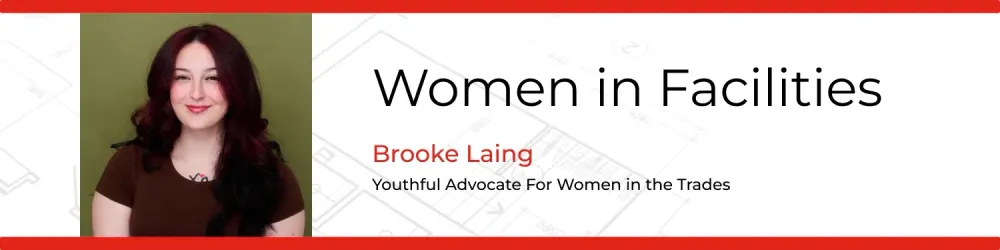
Brooke Laing
Youthful Advocate For Women in the TradesBrooke Laing originally went to college intending to become a diabetes nurse, but quickly realized nursing wasn’t for her and left after about three weeks. At her mother’s suggestion, she explored the trades and chose welding, attending a private trade school and earning multiple welding certifications. She then joined the pipe union after a lengthy wait, becoming a dual-trade steamfitter/welder apprentice and working in the trades for several years. Although she loved the work and would return to it, repeated layoffs and the way women were treated in the industry eventually pushed her to look for something different. About five months ago, she moved into industry media focused on manufacturing, where she is now building a new career.
“We have about 11 shows in the network and I get to travel and talk to different people in the industry, everybody from apprentices to C-suite.” Brooke said. “It’s super fun spending time with people who work on the floor. I also love that I can be an advocate for women in the trades.”
She emphasized the growing value of apprenticeship programs, particularly in manufacturing. Unlike the past, when workers often learned on the job without a formal program, today’s apprentices benefit from structured training and financial assistance that helps employers bring on and develop new talent.
She sees social media as a powerful way to attract and teach the next generation of skilled workers. Many young people discover welding through videos on Instagram and other platforms, then turn to friends and online communities to learn the basics. For her, that shows how the trades can use the same channels to inspire curiosity, share practical knowledge and help young people see skilled trades as an exciting career path.
“There's always going to be people who have the mindset of women don't belong here, these people don't belong here, the trades are for people who aren't smart. So you're always going to be combating that kind of stigma around it all regardless. I think it's just something that I will always do,” she said.
Now in her early 20s, Brooke reflected on how limited her own high school exposure to the trades was. Her school offered only an auto shop program, with no opportunities to explore carpentry, welding, manufacturing or other skilled trades.
She recalled that even her welding instructor, who was only about 15 years older than her, had been encouraged in school to pursue IT and told that the trades were not a good career path. She believes this reflects a larger cycle in which young people are pushed toward whichever career path is seen as the future. For roughly the past decade, she says the skilled trades have faced a major need because the previous generation was heavily encouraged to attend college rather than enter the trades. Her generation has begun shifting that pattern, with more young people choosing skilled trades while others continue pursuing college and professions such as nursing. She believes this cycle will continue.
She sees skilled tradespeople and in-house facilities teams as complementary, particularly when regarding transferring institutional knowledge. There is only so much knowledge one person can pass to the next generation before details inevitably get lost or forgotten. Over time, that knowledge transfer can become a “broken telephone,” with each person retaining only part of what the previous person knew. Outside skilled tradespeople can help fill in those missing pieces when in-house teams encounter something beyond their experience. Ultimately, she believes facilities teams and skilled tradespeople need each other to keep knowledge moving and the work getting done.
Brooke recalled a hospital emergency involving the replacement of a leaking underground diesel fuel tank that supported the backup generator. The tank was leaking five to six liters of fuel a day, so the project required replacing it with two large above-ground storage tanks. Because the generator system was tied into the hospital’s electrical infrastructure, replacing the day tank meant potentially shutting down power throughout the hospital.
The team spent about a month securing approval to bring in a temporary generator and had to schedule the work around the hospital’s dialysis wing, where even a brief power interruption could put patients’ lives at risk. The experience underscored how facilities work in a hospital requires careful planning, coordination and a deep understanding of the building’s critical systems before making a change.
Brooke’s career path has taken a few unexpected turns: as a kid, she wanted to be a forensic scientist investigating crime scenes, then she pivoted to becoming a diabetes nurse. Eventually, she found her way into the skilled trades and, more recently, content marketing.
On the surface, those careers don’t have much in common, but Brooke sees a clear thread running through all of them. Whether you’re investigating a crime scene, caring for a patient, working in the trades or telling stories through content, communication and education are at the heart of the work. In a funny way, she may have changed career directions several times, but the underlying mission has stayed remarkably consistent.
As for career advice, Brooke said, “Ask as many questions as possible. I'll ask the same question to a million different people because I feel like every person that you interact with can give you one valuable takeaway and you can learn something from everybody. I tell everybody that even if you think it's a stupid question, there's probably 100 other people that have the exact same question and are just too scared to ask. So, I always just say, ask all the questions.”