The Renovations-to-Operations Handoff: A Checklist for Getting It Right
Renovations are finished. The contractors have packed up, the ribbon has been cut, the new equipment is running, and everyone is ready to move on to the next project, except facilities.
For the people responsible for operating the building, the real work may just be starting. Where are the updated drawings? Who has the equipment warranties? Were the new systems explained to the maintenance team? And does anyone know exactly where the new shutoff valves are located?
This is the information facilities teams need to maintain equipment, respond to emergencies, manage budgets and keep buildings running.
The handoff from construction to operations needs just as much attention as the renovation itself.
Unfortunately, that's not always how it works.
The handoff that gets forgotten
Keith Karamarkovich, Comcast, pointed to an overlooked problem: Sometimes the handoff process itself gets missed.
"Unless your company has a well-defined process laid out to transition from construction to operations, that actually gets missed a lot of times," Keith explained.
Maria Ruiz, CFM, knows this firsthand. At a university, a culinary teaching kitchen received upgraded cooking equipment. Despite repeated requests to the architect and vendors for warranty information, the facilities team was still trying to sort it out two months later.
Then a stove developed a problem.
When the team contacted the vendor, they were told to figure out the warranty themselves and submit the claim.
The equipment was new. The warranty should have been straightforward. Instead, the facilities team was left chasing information it had requested long before the problem occurred.
It's a familiar scenario: Facilities inherits the equipment, but not necessarily the information needed to support it.
Documentation is an operating tool, not a closeout formality
What information tends to disappear during a renovation?
Warranties, operations and maintenance (O&M) manuals, equipment schedules, manufacturer details, serial numbers, utility routing and shutoff locations are frequent trouble spots.
Maria emphasized that operating information rarely arrives as one organized package. Facilities teams may not participate in the original design discussions, leaving them to learn the building's new configuration after construction is complete.
That creates a costly learning curve.
Consider what happens when a technician needs to isolate a water line, locate an electrical panel or troubleshoot equipment installed during a renovation. Without accurate records, a relatively simple job can turn into hours of tracing pipes, opening ceilings and calling contractors.
Keith described a warehouse expansion that ran into an unexpected complication. After plans were underway to repurpose floor space, the team discovered that a renovation completed two years earlier had installed a power chase beneath the slab. There wasn't a single piece of documentation showing it existed. The discovery forced the team to redesign the space and change plans for equipment placement.
Get facilities involved before the contractors leave
What would make the transition better?
“I recommend bringing together technicians, maintenance managers, building engineers and IT staff for a practical review and walk-through of new equipment, system controls and ongoing maintenance requirements,” she said.
As-built drawings should reflect what was actually installed, not simply reproduce the original design. Field changes need to be recorded as construction progresses, with updates tied to the appropriate change orders.
Before final payment, facilities representatives or qualified third-party reviewers should verify critical details, including valve locations, panel schedules, utility routing and above-ceiling conditions.
Before handing over a renovated space, facilities teams should have a clear picture of what was installed, how it works, where critical components are located and what they'll need to maintain it. The following five-point checklist can help make sure essential information doesn't get lost between construction and operations.
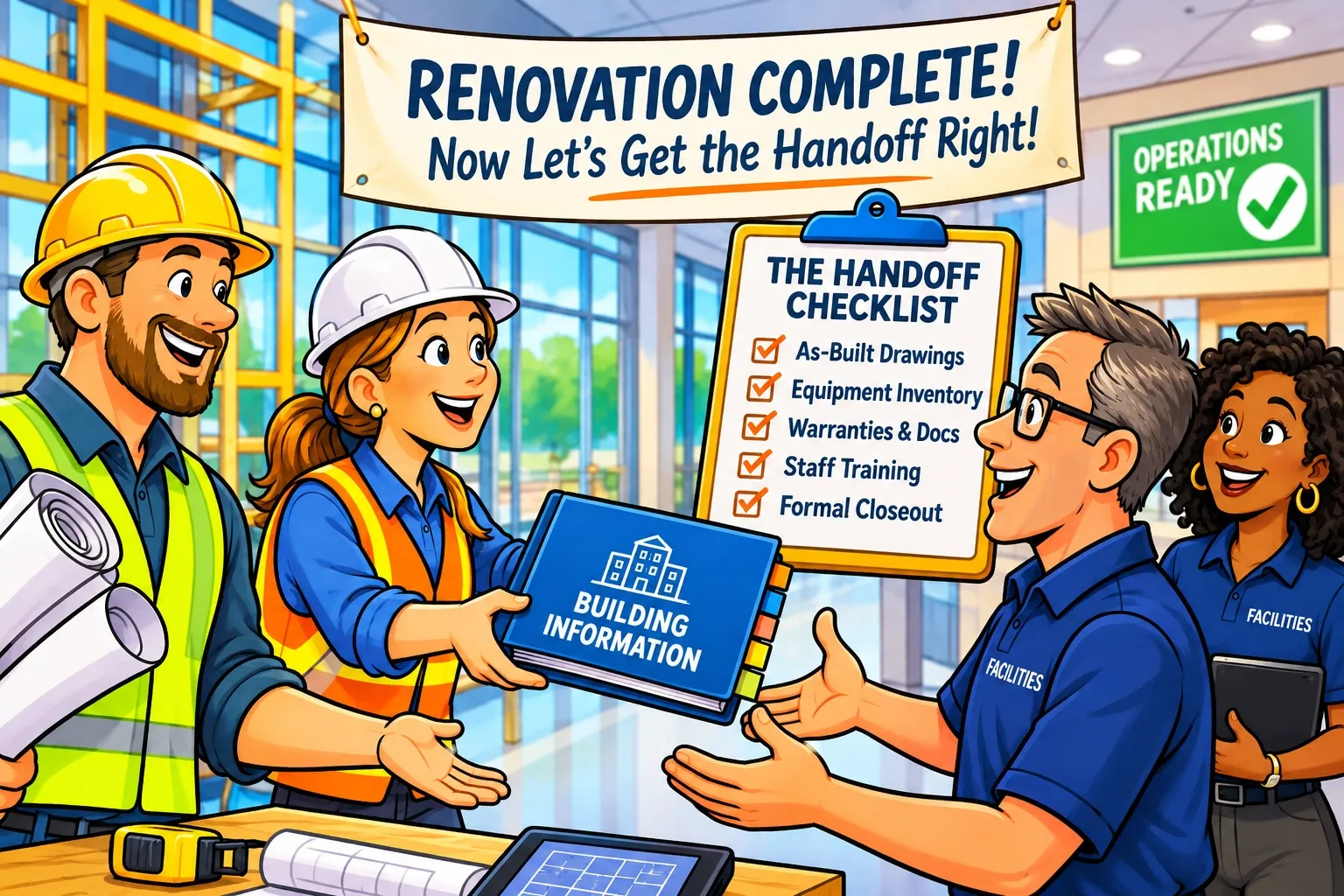
The Renovations-to-Operations Handoff Checklist
1. Verified as-built drawings
- Updated digital and printed drawings
- Utility routing and shutoff locations identified
- Electrical panels and schedules verified
- Field changes documented and linked to change orders
- Critical above-ceiling conditions recorded
2. Complete equipment inventory
- Equipment make, model and serial numbers
- Exact equipment locations
- Asset photos and relevant specifications
- Vendor and service contact information
3. Warranties and operating documentation
- Warranty documents and start dates
- O&M manuals in digital format
- Preventive maintenance requirements
- Contractor and vendor contacts
- Service and replacement recommendations
4. Staff training and walkthrough
- New equipment and system demonstrations
- Operating procedures reviewed
- Training attendance documented
- Questions and outstanding issues addressed
5. Formal project closeout
- Detailed punch walk with architect and general contractor
- Outstanding items assigned and resolved
- Facilities team signs off on the handoff
- Closeout documents delivered in digital and printed formats
- After-action review captures lessons learned
Keith also recommended an after-action report that reviews the project from beginning to end. What worked? What didn't? What needed to be corrected? What should be done differently next time?
That information can help facilities teams improve their processes and give future renovation projects a better starting point.
The bigger takeaway is that the handoff shouldn't be considered complete just because construction is finished or the project manager has signed off.
The people responsible for operating the building need to be part of the final approval. They need more than a promise that someone will email the missing warranty or send over the revised drawings next week.
Building information should follow the building
As facilities teams take responsibility for newly renovated spaces, mobile access to accurate building information becomes increasingly important.
ARC Facilities helps teams organize building plans, equipment information, operating documents and critical facility details in a mobile-first platform.
The goal is straightforward: When a renovation is complete, the knowledge needed to operate the space should be ready to go, too.