Super El Niño Is Coming: Is Your Facility Documentation Ready?
A “Super El Niño” is an unusually strong phase of the El Niño climate pattern when sea-surface temperatures in the Pacific become much warmer than normal. Weather experts pay close attention because strong events can shift rainfall, drought, heat, and storm patterns around the world.
Are you noticing major changes where you live and work now? A prolonged Super El Niño might affect the way you document, maintain and manage your facilities over the next several years.
“Super El Nino and other catastrophic events teach us about our vulnerabilities, whether they are related to buildings, processes or procedures and allow us to define mitigation strategies going forward,” said Ron Coulter, Life Safety & Physical Environment Specialist at Accreditation Commission for Health Care (ACHC).
Ben Greeley, Facilities & Workplace Operations Manager for F5, spent many years in facilities management and disaster response, in hurricane-prone regions like Louisiana. He’s learned that extreme weather events are not isolated incidents and that they become part of the facility's operational history.
“In my experience, facilities that maintain thorough records of flood events, roof leaks, drainage failures, equipment outages, and emergency repairs recover faster and make better capital planning decisions. Rather than simply documenting what failed, I would focus on why it failed, the conditions at the time, and the corrective actions taken. Over several years, that information becomes invaluable when recurring weather patterns begin exposing the same vulnerabilities,” he said.
Ben suggested increasing the frequency of preventive inspections and asset condition assessments because repeated weather events often accelerate deterioration in ways that may not be immediately visible.
For example, ARC Facilities could help a maintenance team document recurring roof leaks, attach photos of affected areas and give technicians field access to repair histories and roof plans before the next major storm.
The biggest lesson Ben learned during hurricane recovery efforts is that you can never have too much baseline information before events occur, including:
- Roof age, repair history, and warranty information.
- Building elevations and known flood-prone areas.
- Locations of mechanical and electrical equipment relative to flood levels.
- Utility shutoff locations and emergency procedures.
- Drainage system capacities and maintenance records.
- Photos of facility conditions before major weather events.
- Equipment inventories, serial numbers, and replacement costs.
- Historical records of previous leaks, flooding incidents, and structural repairs.
In a flooding scenario, ARC Facilities could give response teams mobile access to mapped electrical panels, mechanical equipment and utility shutoffs, helping them identify critical infrastructure and locate the information needed to respond safely.
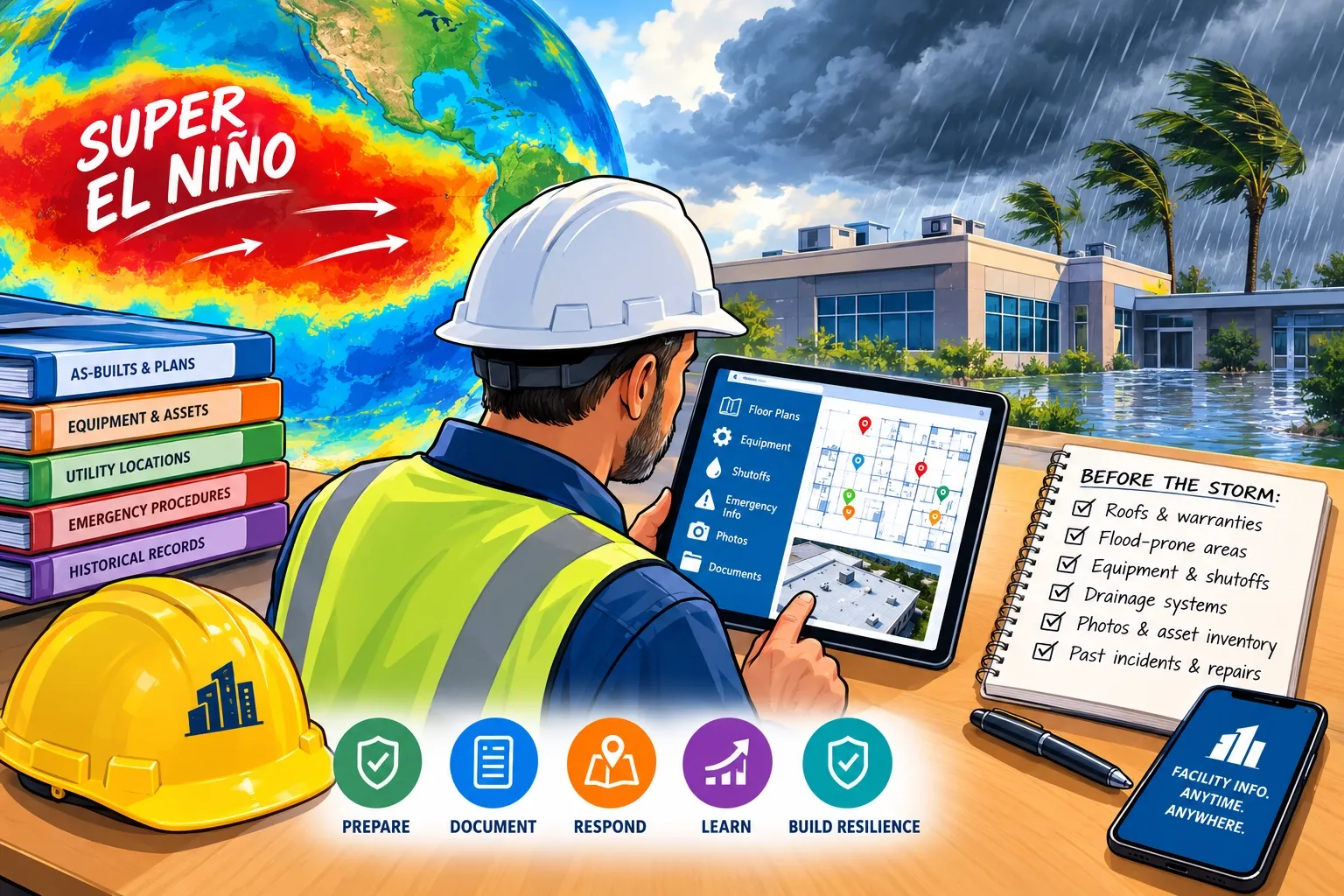
Ben stated that the most successful organizations he’s worked with maintain a living facility history file that includes:
- Storm event timelines.
- Damage assessments.
- Before-and-after photographs.
- Repair records.
- Insurance claims information.
- Vendor reports and recommendations.
- Capital improvement projects.
- Lessons learned from response and recovery efforts.
After a storm, ARC Facilities could help teams document damaged equipment, record repairs, associate supporting photos and update facility information so future teams can reference what happened and what was done.
He summarized by saying that a lengthy Super El Niño would likely teach future facility teams about:
- Which areas flood first
- Where roof systems are most vulnerable
- How drainage systems perform during record rainfall events
- Which building systems are resilient and which consistently fail
- How long facilities can operate on emergency power
- What mitigation projects provided the greatest return on investment.
Global Facility Management leader Michell Olausson added that he would also want to know which assets are critical to business continuity and which areas have the highest consequence if they fail.
“A small roof leak in one location may be manageable. The same leak above critical electrical equipment, IT infrastructure or a sensitive operational area can become a major business event,” he explained.
Michell believes that identifying patterns is especially valuable in FM because it allows organizations to move from reactive maintenance toward risk-based decision-making.
The question becomes less “How many work orders did we close?” and more “What is this asset history telling us about future risk?”
He also emphasized that FM teams should capture both technical and operational lessons: what failed, what performed well, where access was difficult, which information was missing, which suppliers or resources were critical and what decisions could have been made earlier.
He would treat this almost as a building-specific lessons-learned process. The result should feed back into maintenance plans, emergency preparedness, capital planning and future design decisions.
Extreme weather can put facilities under pressure from multiple directions, whether it’s freezing temperatures, heavy rain, flooding, high winds or prolonged heat. ARC Facilities helps teams prepare by keeping building plans, equipment details, utility locations and emergency information organized and accessible on mobile devices. When conditions deteriorate, staff can make informed decisions, pinpoint critical systems and coordinate a response with a clearer picture of the building and its vulnerabilities.