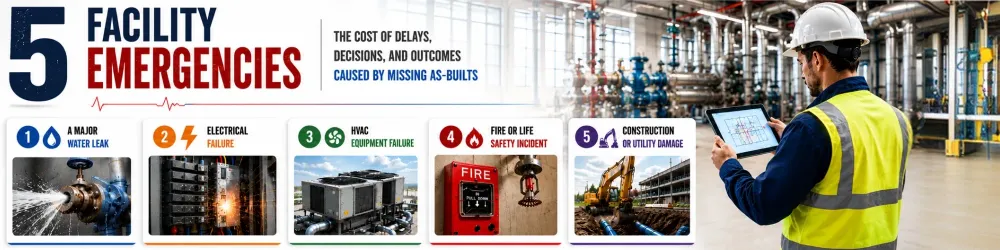
Five Facility Emergencies
The Cost of Delays, Decisions, and Outcomes Caused by Missing As-BuiltsFacility emergencies rarely happen at convenient times. When a power outage, water leak, equipment failure, or fire alarm goes off at 2 a.m., facilities teams need accurate building information immediately.
Most organizations already have as-builts, O&M manuals, equipment documentation, commissioning reports, warranties, and renovation records. The problem is that critical building information often isn't organized for technicians in the field. Every minute spent searching delays decisions, extends downtime, complicates repairs, and increases costs.
Here are five emergencies that show why accessible documentation matters.
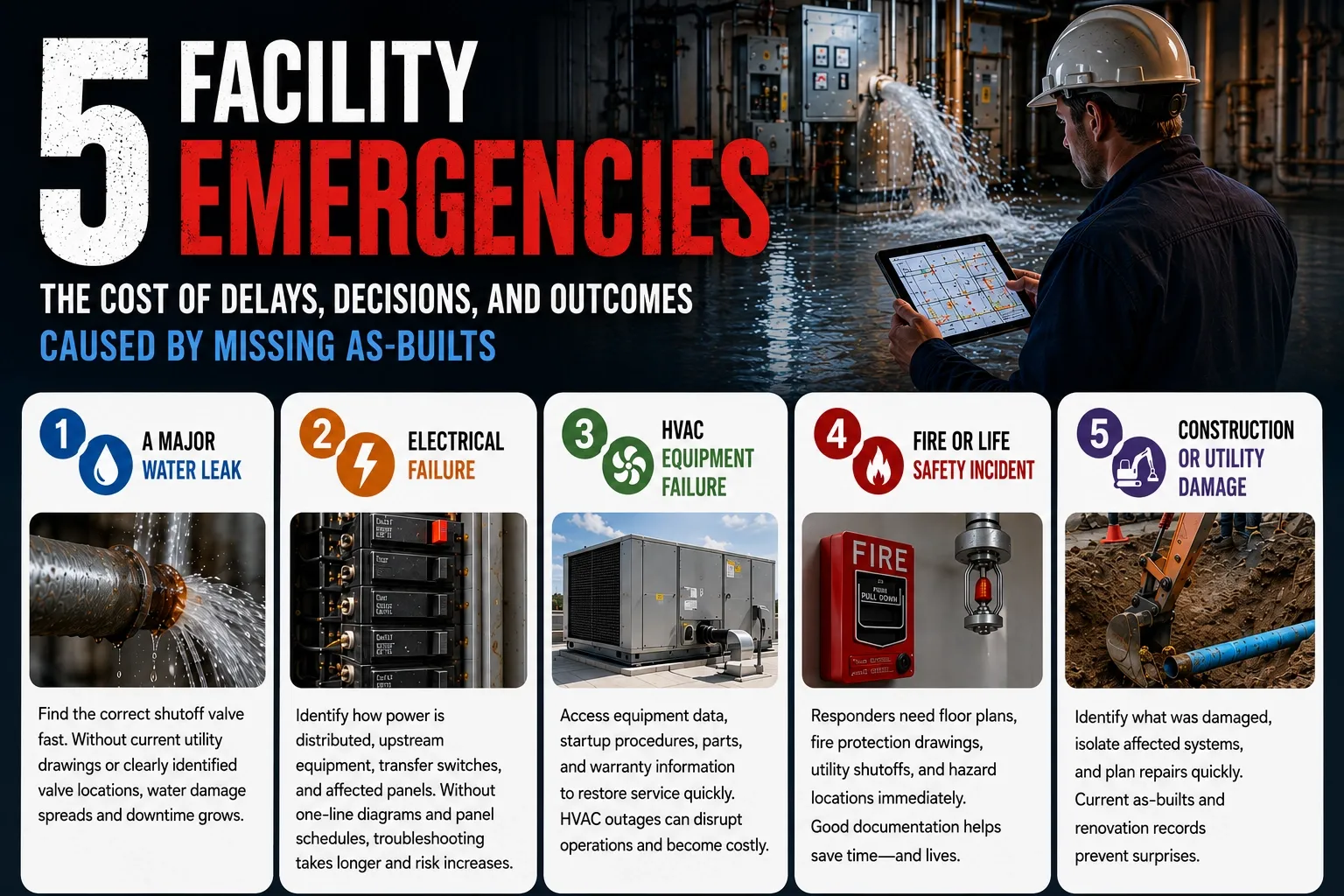
1. A Major Water Leak
Whether it's a burst pipe, failed valve, or broken sprinkler line, water damage spreads quickly. The first priority is finding the correct shutoff valve before water reaches electrical equipment, patient areas, classrooms, manufacturing lines, or occupied offices.
Without current utility drawings or clearly identified valve locations, technicians lose valuable time determining which valve controls the affected area.
2. Electrical Failure
When a breaker trips or a major electrical component fails, technicians need to understand how power is distributed throughout the building. They may need to identify upstream equipment, transfer switches, emergency power connections, or affected panels.
If one-line diagrams, panel schedules, and equipment documentation aren't immediately available, troubleshooting takes longer and the risk of mistakes increases.
3. HVAC Equipment Failure
When an air handler, chiller, boiler, or rooftop unit unexpectedly fails, maintenance teams need equipment documentation, replacement part information, startup procedures, and warranty records.
Without those resources, valuable time is spent locating information instead of restoring service. For hospitals, laboratories, manufacturing facilities, and data centers, even a short HVAC outage can interrupt operations and become costly.
4. Fire or Life Safety Incident
During a fire alarm, sprinkler activation, or other life safety event, responders need immediate access to floor plans, fire protection drawings, utility shutoffs, hazardous material locations, and building layouts.
Because first responders are often unfamiliar with the facility, engineers and maintenance teams become the primary source of critical building information.
When documentation is organized and immediately available, emergency personnel can make better-informed decisions while valuable time is still on their side.
5. Construction or Utility Damage
A contractor cuts into a water line. A renovation uncovers undocumented utilities. An excavation damages buried electrical or communications infrastructure.
Current as-builts and renovation records help facility teams identify what was damaged, isolate affected systems, and plan repairs more quickly.
Documentation Is Part of Emergency Preparedness
Emergency preparedness isn't just about generators, emergency plans, and training. It's also about making critical building information available to the people who need it.
Every facility should maintain current:
- As-builts
- Utility shutdown locations
- O&M manuals
- One-line electrical diagrams
- Equipment documentation
- Commissioning reports
Good Documentation Improves Every Response
Every facility has a "Bob"—the technician who knows where hidden shutoffs are, which drawings can be trusted, and how systems have changed over years of renovations. The problem is that much of this institutional knowledge exists only in Bob's head. When he retires, decades of experience often leave with him.
ARC Facilities helps organizations capture and preserve that knowledge by connecting as-builts, O&M manuals, equipment information, photos, shutdown procedures, and field notes in one mobile platform. Instead of relying on institutional memory, every technician has access to the same trusted building information, helping teams respond more effectively and preserving critical knowledge for the next generation.
Is Your Facility Ready?
If your emergency response depends on knowing who has the latest as-builts or where critical documentation is stored, it may be time to rethink your approach.
Schedule an ARC Facilities demonstration for a closer look at centralizing facility documentation and preserving institutional knowledge.
Frequently Asked Questions
What are as-builts, and why do they matter during an emergency?
As-builts are updated plans that reflect how a building was actually constructed, including renovations, rerouted utilities, and field changes. During an emergency, they help teams locate shutoff valves, trace circuits, and understand how systems connect.
What documents should every facility maintain?
At a minimum: current as-builts, utility shutdown locations, O&M manuals, one-line electrical diagrams, equipment documentation, commissioning reports, warranties, and emergency response procedures. The information usually exists—the question is whether technicians can retrieve it in seconds.
How often should documentation be updated?
Update documentation whenever renovations, equipment replacements, or utility modifications occur, and review emergency plans at least annually.
Where should facility documentation be stored?
Critical building information should be available from the field, ideally on a mobile device, so technicians can retrieve as-builts, equipment documentation, utility shutoff information, and emergency procedures the moment they're needed.