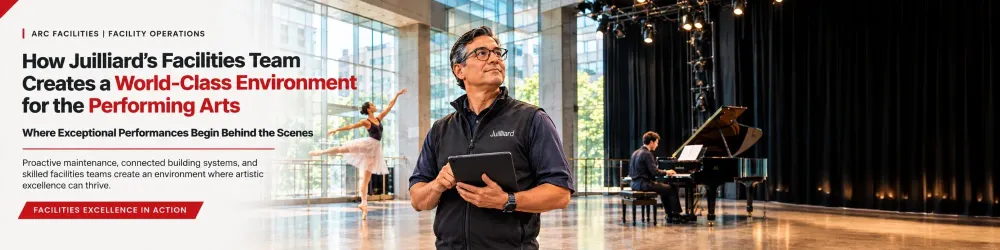
How Juilliard’s Facilities Team Creates a World-Class Environment for the Performing Arts
At The Juilliard School in New York City, excellence in the arts extends to the buildings, equipment, maintenance programs and people who keep the institution running. For Paul Sutter, Associate Vice President of Facilities and Capital Projects, the mission is straightforward: create and maintain a physical environment that supports students, faculty and staff at the highest possible level.
Paul discussed the demands of managing Juilliard's facilities, developing a strong in-house team, planning capital improvements and adapting to rapidly changing technology, with David Trask, ARC Facilities, host of the Facility Voices podcast.
Facilities Management Is Part of the Institution's Mission
Julliard’s footprint includes a 28-story residence hall and a 500,000-square-foot building housing classrooms, offices, practice rooms and performance spaces.
The facilities team's responsibility goes well beyond keeping the lights on and equipment running. The physical environment needs to reflect the same level of excellence expected from the students and faculty.
That means immaculate classrooms, welcoming public spaces, properly maintained theaters and practice rooms equipped to support serious artistic development.
The facilities department supports more than 700 events annually, handling everything from theater seating and room configurations to event setups, custodial services and building maintenance.
His team's work is an extension of Juilliard's educational mission. When students have the right environment, they play and perform better.
A Collection of Connected Systems
One of Paul's management strategies is an approach he calls "container comp." The concept treats a building as a collection of containers. Everything inside those spaces becomes a compartment. This way of looking at facilities helps his team understand how building systems relate to one another.
Reconfiguring an office isn't simply a matter of moving walls and furniture. The team must consider HVAC returns, electrical outlets, lighting and other infrastructure affected by the change.
This holistic perspective helps facilities and capital project managers evaluate the consequences of modifications before work begins. It's particularly valuable in a complex environment like Juilliard, where specialized spaces and interconnected building systems require careful coordination.
Juilliard presents scheduling challenges and the school's performance-driven environment adds another layer of complexity. The academic calendar determines when major maintenance projects can happen. Summer becomes a critical window for large-scale repairs and equipment replacements. During the academic year, the facilities team must work around classes, rehearsals, performances and individual practice schedules.
One of his assistants spends approximately 90% of her time coordinating schedules and accommodating the needs of different departments. Even relatively minor repairs require consideration. If a light goes out while a student is practicing, the team may wait until the student finishes before making the repair, unless there's a safety concern. It’s risky to read Beethoven in the dark.

Creativity Is Essential When Space Is Limited
Juilliard has little room to expand. His team regularly repurposes underutilized spaces to serve new purposes. An old mechanical or storage area might become office space. An existing room might be redesigned to accommodate additional employees. One former underused space was transformed into a wellness and lactation room for new mothers. These projects require imagination, collaboration and the ability to look at floor plans differently.
Building Expertise From Within
Perhaps Paul's greatest source of pride is his facilities team.
Juilliard has developed substantial in-house expertise. Engineers and tradespeople can diagnose complicated equipment issues, understand system behavior and conduct repair strategies themselves.
That knowledge allows the team to anticipate potential problems. If one component fails, historical experience may indicate that similar components should be inspected or replaced proactively.
Paul looks for employees who take pride in their work, bring positive energy and genuinely want to support the institution's mission. It helps if they love music, too.
Five Important Takeaways for Facilities Teams
1. Connect facilities performance to organizational success. Understand the institution's mission and make sure building conditions, cleanliness, comfort and functionality support its larger goals.
2. Think about buildings as interconnected systems. Before changing a room, replacing equipment or modifying infrastructure, consider how HVAC, electrical, lighting and other components work together.
3. Make scheduling part of your maintenance strategy. Coordinate projects with the people who use the spaces. Academic calendars, business hours, special events and operational priorities should influence maintenance windows.
4. Plan for technology obsolescence. Evaluate equipment life cycles, manufacturer support, integration requirements and future replacement costs before committing to major technology investments.
5. Invest in your people and their expertise. Build a team that understands the facility, takes ownership of its work and can diagnose problems without always depending on outside contractors.
Appreciation for the Arts
Working at Juilliard is personally rewarding. He described walking through the building and hearing Bach, discovering students practicing in unexpected places or catching glimpses of dance rehearsals.
Those moments remind him that facilities management is about much more than maintaining infrastructure.
It's about creating an environment where people can do extraordinary things.
And that's a lesson that applies well beyond the performing arts. Whether managing a university, hospital, corporate campus or school district, facilities teams play an important role in helping their organizations fulfill their missions.
Want to hear more from facilities leaders like Paul? Tune into Facilities Voices for conversations with professionals sharing real-world lessons, strategies, and ideas from the front lines of facility management.
ARC Facilities helps organizations put many of these proactive practices into action by bringing critical building information, equipment details, documentation, and operational knowledge together in one place, helping facilities teams spend less time searching and more time solving problems.