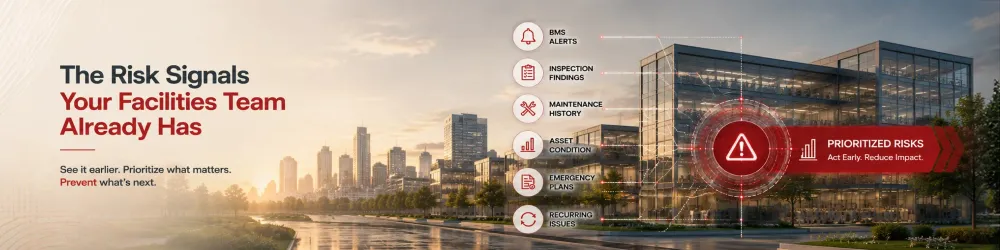
The Risk Signals Your Facilities Team Already Has
Facilities and risk management may have different responsibilities, but they share a common concern: protecting people, buildings and organizations.
That overlap was the focus of a recent discussion in the IFMA Engage community. The conversation quickly moved beyond the traditional idea of risk management and into a broader question: How can facilities teams use the information they already have to identify risk earlier, prioritize what matters most and make better decisions about buildings and assets?
FM has a broad view of organizational risk
Karim Reda Mustafa Mustafa Abdelgawad, Senior QHSE Manager at Prosper Egypt Facilities Management, described an integrated approach in place at his organization.
“My company works with risk management and facility management together through risk assessments, HSE compliance, emergency preparedness, business continuity, asset protection, and operational audits. This integrated approach helps protect both staff and facilities while ensuring business continuity and service quality in a good condition.”
David Landis, Real Estate Project Manager, took that idea further. He sees facilities management as particularly well positioned to coordinate risk because FM interacts with so many parts of an organization.
“In most organizations there is not another department better suited than FM to consolidate and coordinate the overall site risk program.”
Why? Because facilities teams see a lot of what happens inside a building. They interact with departments, occupants, contractors, equipment, maintenance systems and business operations.
David suggested that this visibility gives FM a natural role in bringing information together and developing a formal risk management plan. He also emphasized that risk planning shouldn't be a once-a-year exercise.
He pointed to systems that can support that ongoing process, including asset maintenance, capital plans, facility and equipment tours, emergency plans, safety audits, security tours, inspections and training.
Documentation is important. So is asset condition.
Luigi Armogida, Higher Education Division Manager at The Garland Company, Inc., introduced another distinction that can easily get lost in conversations about facility risk: documentation versus condition.
Having accurate drawings, inspection records and asset information matters. But documentation tells us what we know about a building. It doesn't necessarily tell us what condition the building is in today—or what could fail next.
Luigi posed the question this way:
“Do we understand the current condition of the asset well enough to know where the next significant failure is most likely to occur?”
That question becomes especially important for roofs and building envelopes, where deterioration can happen gradually and remain largely unnoticed until a failure forces everyone's attention onto the problem. His suggestion is to shift the conversation from documenting past events toward identifying future exposure.
“I think the opportunity is to move the conversation from "Can we document what happened?" toward "Can we identify, quantify and prioritize the risk before it becomes an emergency?"”
That shift also changes the conversation around capital planning. Instead of simply asking for money to maintain an aging asset, facilities leaders can show risk management and finance what could happen if maintenance is deferred—and what that exposure could mean for the organization.
Having data isn't the same as knowing what to do first
Tom Wright, President of Peak Amp Instruments, added another layer to the discussion: prioritization.
Facilities teams may have a tremendous amount of information available through BMS alarms, inspection records and asset information. But information alone doesn't necessarily answer the question facilities leaders face every day:
“What should we address first?”
Tom sees an opportunity to connect existing data sources so facilities teams can identify emerging equipment risk, understand the operational impact of waiting and develop a defensible priority list for leadership and finance.
That builds on David’s point about continuously incorporating inspection information into risk planning.
Tom also reframed David’s question about missed risk:
“The more interesting question may eventually become not just "What risk did we miss?" but "What signals did we already have that could have helped us see it earlier?"”
That's an important distinction.
A missed risk is something the organization didn't anticipate. A missed signal is different. The information may have been there—the alarm, inspection result, maintenance history, asset condition or recurring problem—but nobody connected the dots.
Turning risk information into action
The discussion ultimately points to a larger opportunity for facilities organizations.
Risk management doesn't have to be a separate exercise that happens alongside facility operations. It can become part of how facilities teams manage buildings every day.
That means connecting information about asset conditions, maintenance history, inspections and emergency plans and training and reporting.
It also means keeping that information current enough to support decisions, not simply storing records for the next inspection, audit or emergency.
The big questions remains: What information did we already have and how can we use it earlier?
Mitigating risk starts with having the right information. ARC Facilities helps organizations bring building plans, asset information, inspection records, emergency information and other critical documentation together, giving facilities teams a clearer picture of their buildings and the information they need to identify risk, prioritize action and make better decisions. Risk will always be part of facilities management, but having current, reliable information can help teams recognize warning signs earlier and reduce operational exposure.