When Weather Gets Wild, Will Your Team Be Ready?
Unpredictable and constantly changing weather conditions mean that facilities teams must always be poised, prepared and positioned to anticipate, respond and recover from what’s in the forecast.
Our Severe Weather Facilities Readiness Checklist was created to help you identify information, equipment and knowledge gaps before severe weather turns manageable issues into major disruptions, a webinar topic addressed by Sahra Siddiq from ARC Facilities in 5 Facilities Issues to Prepare for Before Severe Weather Hits.
While weather is always changing, one trend that continues to hit facilities hard is the loss of institutional knowledge caused by long-time staff members leaving buildings with decades of know-how, which Sahra described as a gold mine in their minds.
Severe Weather Facilities Checklist
1. Water Leaks, Flooding & Water Intrusion
When water is moving, the priority is being able to identify the source and isolate it quickly. Sahra specifically called out shutoffs, valve locations, plumbing plans, and building drawings as information the responder may need immediately.
Shutoffs & Valves
- Identify and document critical water shutoff locations
- Identify isolation valves for major building areas and systems
- Clearly label shutoffs and valves in the field
- Verify that labels and documented locations are still accurate
- Photograph critical shutoffs so responders know what they are looking for
- Document any special instructions for reaching or operating a shutoff
Building Information
- Confirm current plumbing plans are available
- Confirm current building drawings are available
- Identify where responders will find this information after hours
- Make sure information can be understood by someone unfamiliar with the building
- Verify responders don't have to return to an office or plan room to find critical information
Readiness Test
- Give a newer employee this scenario: “Water is coming through the ceiling. Find the correct shutoff.”
- Don't help them—see if they can locate what they need independently
- Note every call, folder search, office trip, or “I don't know” as a preparedness gap
2. Power Outages & Electrical Issues
Preparation needs to go beyond confirming that generators work. Teams should understand what the generators support, what happens when utility power disappears, what needs to be restarted, and which loads are critical.
Emergency Power
- Create an emergency power map
- Document which buildings each generator supports
- Document which electrical panels each generator supports
- Identify the critical systems supported by each generator
- Test generators under realistic outage conditions—not just whether they start
Restart Procedures
- Identify equipment that does not automatically restart when power returns
- Document required manual interventions
- Document the correct restart sequence
- Make instructions available to whoever may be responding
Critical Loads
- Maintain a current critical-load list
- Identify servers and IT infrastructure that must remain operational
- Identify freezers/refrigeration that must remain operational
- Identify security systems
- Identify fire and life-safety systems
- Identify elevators
- Identify research, laboratory, or other mission-critical equipment
Panels & Electrical Information
- Physically verify electrical panel labels
- Compare panel schedules with what is actually connected
- Update documentation after renovations or system changes
- Confirm electrical drawings and panel information are current
Knowledge Risk
- Identify electrical/building systems understood by only one person
- Document that employee's knowledge before it is needed
- Make sure another employee can find and understand the information without calling them
3. HVAC & Equipment Failures
The goal isn't simply to know what equipment you own. A responder needs to know what it serves, where it is, what parts it needs, and anything unusual learned from years of maintaining it.
Equipment Identification
- Maintain a current equipment inventory
- Document the exact location of each critical asset
- Document which rooms or spaces each unit serves
- Record make and model
- Record serial number
- Photograph equipment nameplates
Parts & Maintenance
- Document filter sizes
- Document belt sizes
- Maintain information on commonly replaced parts
- Make replacement-part information easy for technicians to find
Troubleshooting Knowledge
- Document unusual troubleshooting history
- Record known equipment quirks
- Capture workarounds veteran technicians have learned over time
- Document “check this first” knowledge that isn't found in the O&M
- Make that information understandable to someone who hasn't worked on the equipment before
Operational Risk
- Identify critical equipment with no redundancy
- Identify the spaces or operations affected if that equipment fails
- Make sure technicians can determine which unit serves which space without relying on a veteran employee
4. Roof & Storm Damage
Sahra made an important distinction here: storms often expose an existing roof problem rather than create it. That makes pre-season preparation especially important.
Pre-Season Roof Inspection
- Conduct a roof walk before storm season
- Inspect roof drains
- Inspect flashing
- Inspect penetrations
- Inspect membrane condition
- Inspect areas around rooftop equipment
- Clear drainage paths
Documentation
- Maintain a history of previous roof leaks
- Document recurring problem areas
- Photograph roof conditions before storm season
- Know which roof areas are covered by warranties
- Make warranty information easy to locate
Emergency Vendors
- Identify your roofing contractor before an emergency
- Identify your electrician
- Identify your restoration company
- Identify other critical emergency vendors
- Make contact information readily available to the team
- Confirm who should be called for each type of incident
Don't wait until a regional storm hits to start looking for contractors—other organizations will be calling them at the same time.
5. After-Hours Response
This is where the other four issues come together. As Sahra said, preparedness isn't measured by what the most experienced Facilities Director can find; it's measured by what the least experienced person who might be responding can find.
The “New Employee at 2 AM” Test
Give a newer employee these three scenarios:
Scenario 1: Water is coming through the ceiling in Building A.
- Can they find the correct shutoff?
- Can they find the appropriate plumbing/building information?
- Do they know what to do next?
Scenario 2: Power is out in Building C.
- Can they determine what emergency power is available?
- Can they identify affected panels and critical systems?
- Can they find restart procedures?
Scenario 3: An HVAC unit serving a critical space has failed.
- Can they identify which equipment serves the space?
- Can they locate the equipment?
- Can they find the equipment information and troubleshooting history?
For every scenario, record whether the employee must:
- Call another employee
- Search multiple folders or systems
- Return to an office
- Search through paper documents
- Rely on information stored in someone's head
- Say, “I don't know.”
Each one identifies a preparedness gap.
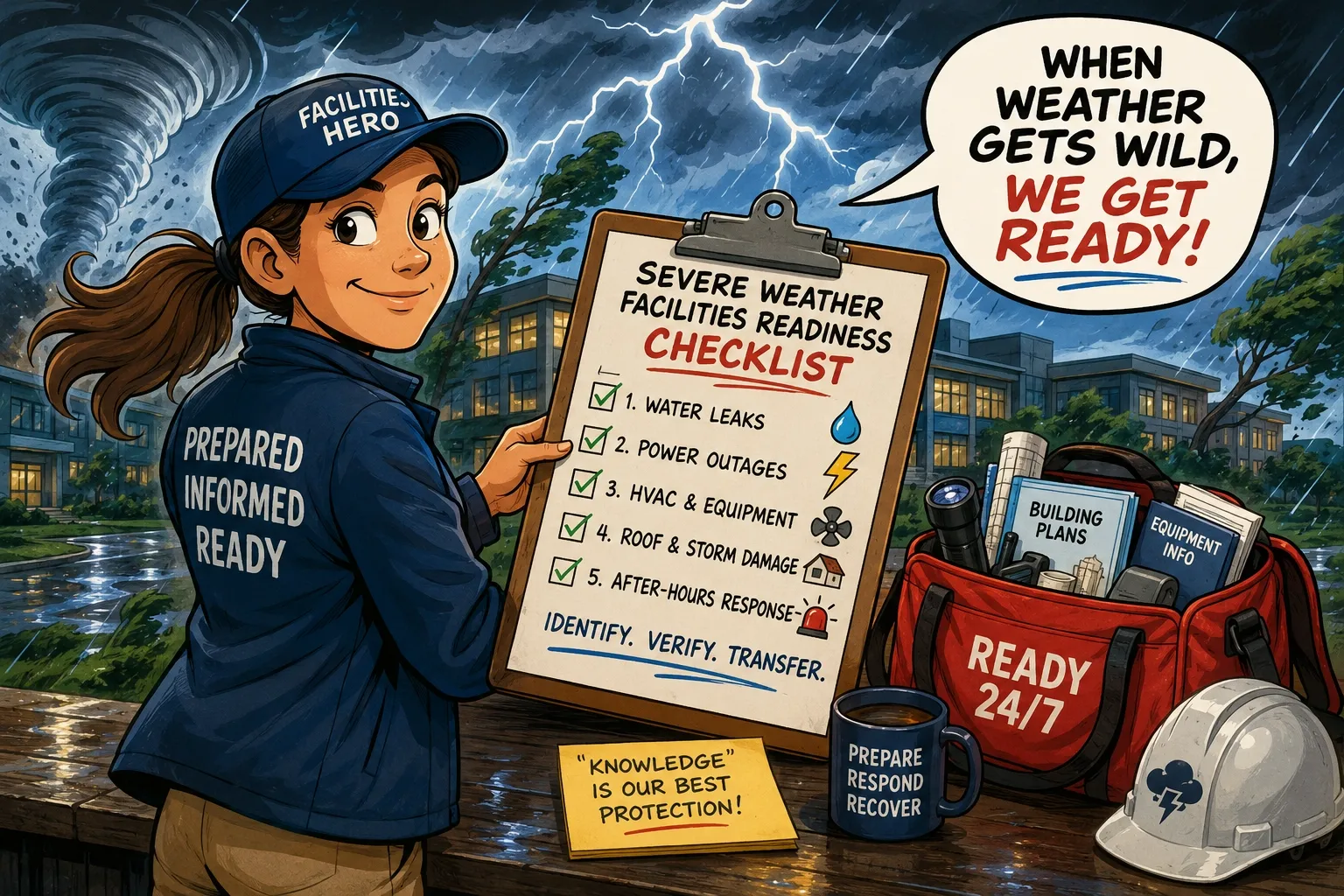
Final Readiness Check: Identify. Verify. Transfer.
Sahra boils the exercise down to three priorities.
IDENTIFY
- What are our critical assets?
- What are our critical shutoff systems?
- What documents would we need during an incident?
- What information absolutely cannot be difficult to find?
VERIFY
- Is the information we have today actually correct?
- Are drawings current?
- Are labels accurate?
- Have field conditions changed?
- Have renovations made older information obsolete?
TRANSFER
- Could someone other than the person who created the documentation understand it?
- Is critical knowledge documented rather than stored in someone's head?
- Could a newer employee use it without assistance?
- Would the information still be available if an experienced employee retired, transferred, was sick, or was on vacation?
The final question
After reading this checklist, think about how to make building knowledge and emergency information accessible and understandable to strengthen stewardship, trust and resilience in your organization.