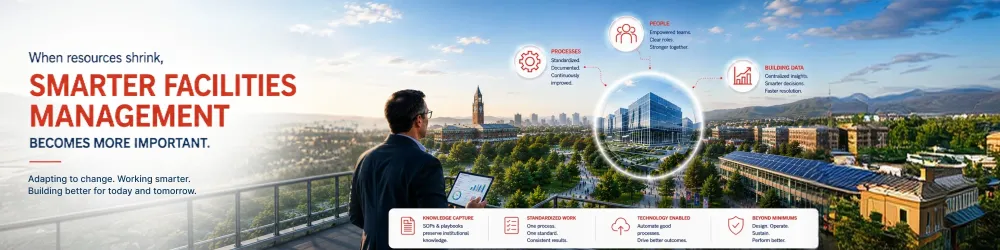
Mission: Better FM
Skip Vaughn, Assistant Vice President of Facilities Management at American University, brings experience from construction, the Coast Guard, federal facilities and higher education, with roles as a contractor, construction manager, owner’s representative, federal facilities leader and FM shaping how he approaches problems from multiple perspectives.
Military experience translates to FM
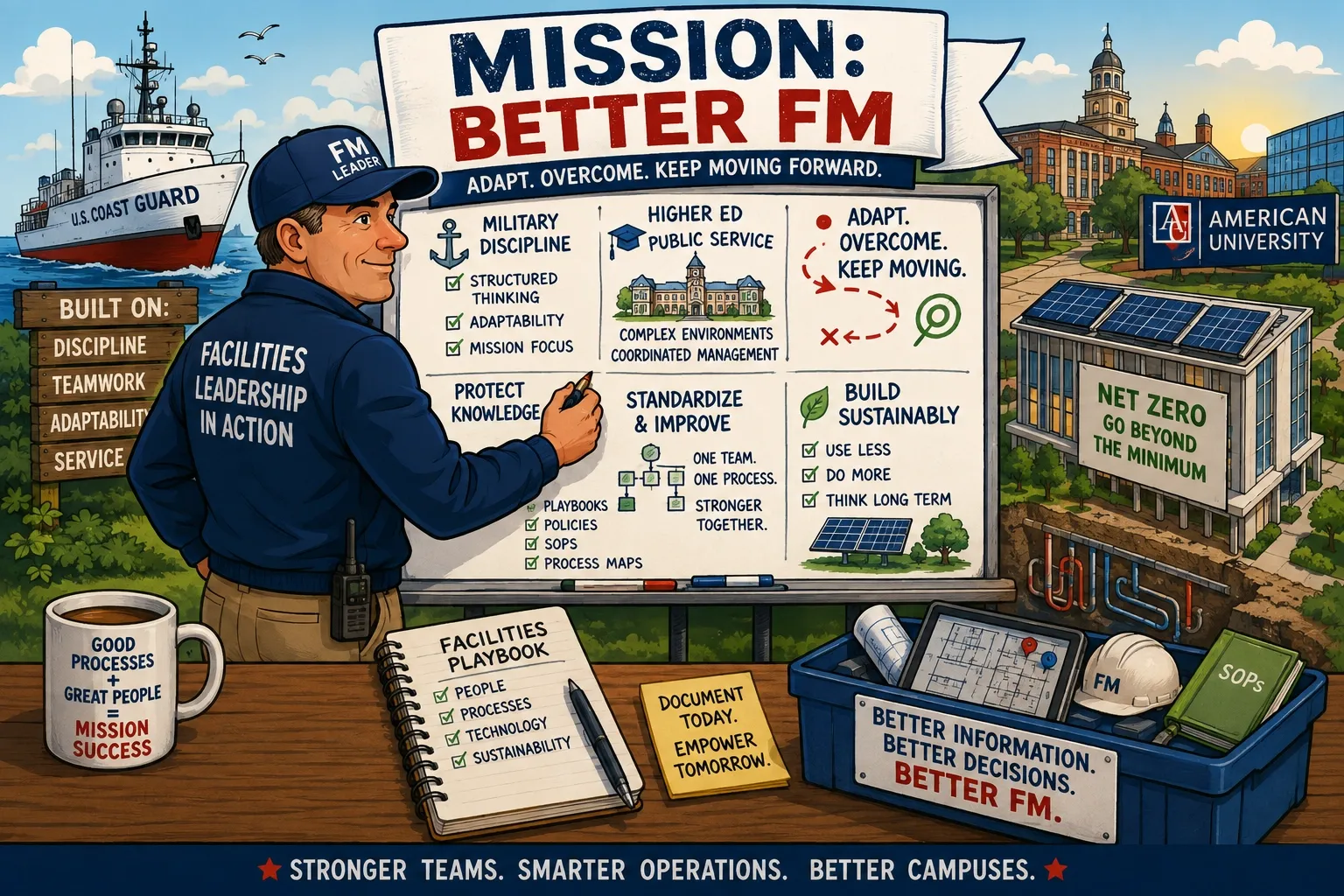
He credits the Coast Guard with teaching him discipline, structured thinking, time management, multitasking and adaptability. Because military personnel often handle multiple responsibilities, he sees that experience as strong preparation for facilities management.
His philosophy: adapt, overcome and keep moving forward. Resource constraints should prompt FM teams to rethink how work gets done rather than simply accept limitations.
Higher ed and changing resources
Skip sees higher education as another form of public service and a natural fit for his facilities background. University campuses, like military bases, are complex environments requiring coordinated management of buildings, infrastructure and people.
But higher ed is facing declining enrollment, funding changes and a projected decline in the number of high school graduates. At American University, those pressures contributed to significant staffing reductions, including the loss of about 20% of Skip's facilities workforce shortly after he arrived.
Rather than simply doing less, Skip saw an opportunity to reorganize, eliminate unnecessary services and improve efficiency.
Protecting institutional knowledge
The loss of experienced employees also creates another risk: institutional knowledge walking out the door.
Skip is addressing that by developing playbooks, policies and SOPs for everything from major campus events to everyday processes. When his team mapped workflows, they discovered some tasks were being handled four or five different ways.
Documenting and standardizing those processes reduces dependence on individual employees and makes the organization more resilient.
Sustainability beyond the minimum
American University has a long-standing sustainability focus. Skip discussed the Meltzer Center for Athletic Performance, designed for net-zero energy performance and LEED Platinum certification, incorporating solar, geothermal and a highly efficient building envelope.
For organizations pursuing net zero, his advice is to start with fundamentals: reduce energy use, improve building envelopes, evaluate solar and consider high-performance technologies.
Don't simply meet the minimum certification requirements. Design and operate buildings to be as efficient as possible.
Facilities Team Takeaways:
- FM rewards adaptability. Multitasking, discipline and problem-solving are critical in complex facilities environments.
- Military experience translates well to FM. Campus operations share many characteristics with military facilities.
- Staff reductions can prompt better thinking. Use resource constraints to identify unnecessary work and improve processes.
- Document knowledge before people leave. SOPs, playbooks and process maps preserve institutional knowledge.
- Standardize recurring work. Different approaches to the same task create inconsistency and unnecessary complexity.
- Pair technology with process improvement. Automate good processes—not inefficient ones.
- Make efficiency the foundation of sustainability. Better envelopes, systems and energy management matter alongside renewable energy.
- Think beyond minimum requirements. The goal isn't simply certification; it's creating buildings that perform better over time.
Want to hear more from facilities leaders like Skip? Tune into Facilities Voices for conversations with professionals sharing real-world lessons, strategies, and ideas from the front lines of facility management.
ARC Facilities helps organizations put many of these proactive practices into action by bringing critical building information, equipment details, documentation, and operational knowledge together in one place, helping facilities teams spend less time searching and more time solving problems.