
If Drawings Could Speak, Oh the Stories They’d Tell
When a construction project wraps up, it leaves behind a surprising amount of documentation, including submittals, O&M manuals , commissioning reports, warranties, equipment specifications, and testing records, all of which contain important details about how the building was designed, installed, tested, and intended to operate.
Unfortunately, those materials rarely end up in one accessible location. Some live on shared drives, some are buried in email threads, and others end up in storage boxes that become difficult to locate only a few months after the project is complete. At the same time, the building’s plans are often stored somewhere else entirely, creating a disconnect between the visual record of what was built and the supporting information that explains how everything works. But some closeouts never even make it to facilities or there are year-long delays.
At first glance, this may not seem like a serious issue because the drawings appear to tell the story of the building. After all, they show where equipment was installed, how systems are routed, and how spaces are organized.
But for the people responsible for operating and maintaining that building over the next several decades, drawings only capture part of the picture because a building’s real story lives in the details behind those drawings.
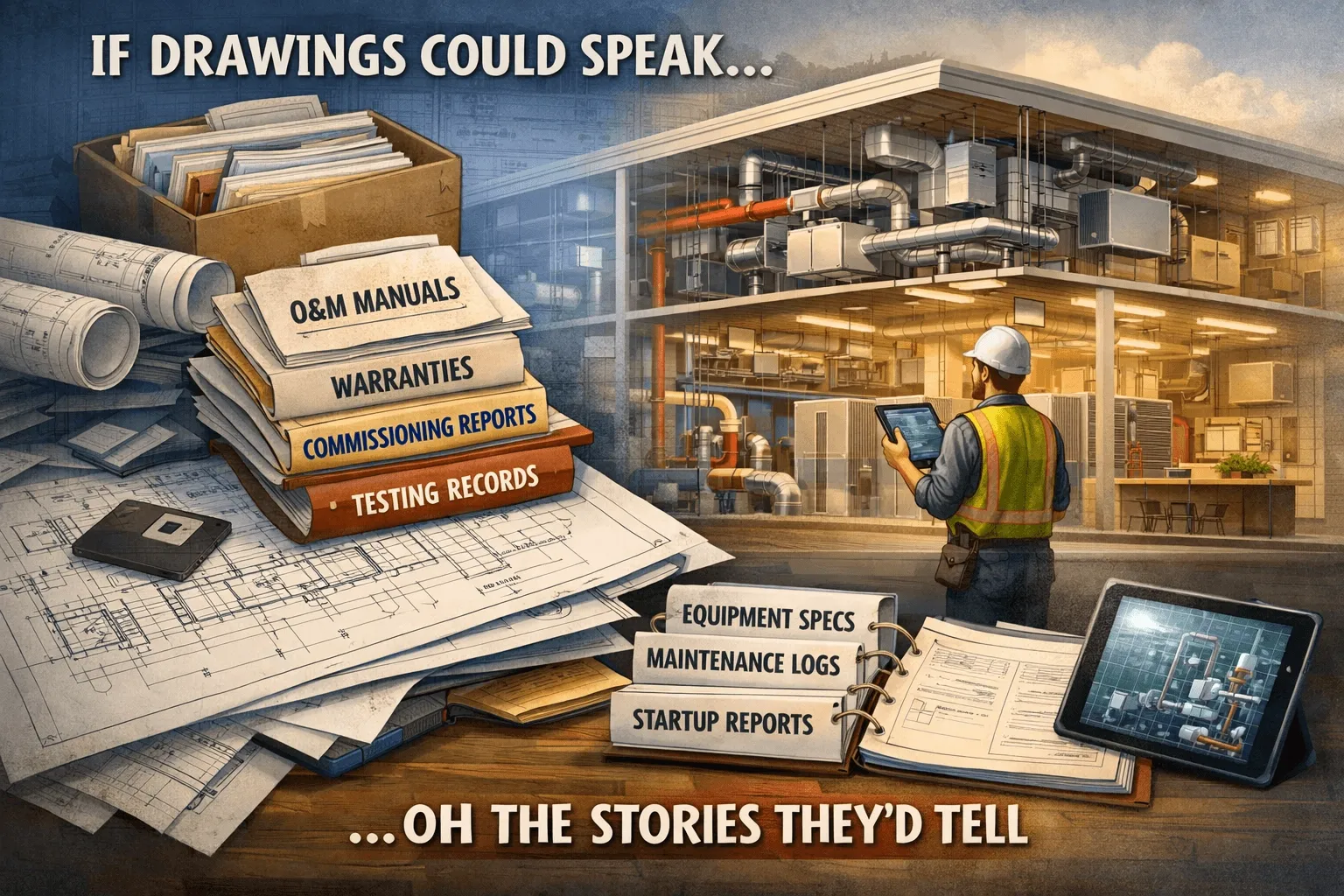
Drawings Show the Structure. Closeouts Explain the Systems.
As-built drawings show where systems are located, what equipment was installed and how spaces are organized so teams don’t have to take wild guesses or hope retired guys like Carl will remember critical details – which cause delays and potential damage to infrastructures.
Closeout documentation provides the deeper context because submittals, commissioning reports, startup data, and O&M manuals explain how systems were expected to perform, how they were tested, and how they should be maintained over time.
One facilities leader said that as-builts and O&M manuals often go unused after turnover because when questions come up later, teams frequently end up going back to the construction project manager simply because nobody can find the original information or nobody knows where it was stored.
Another pointed out that as-builts become especially valuable when teams need to trace plumbing pathways, electrical work, stormwater systems, and catch basin maintenance because those drawings can help explain what is hidden behind walls, under floors.
And when it comes time for a major remodel, the value of these records only grows because future project teams can trace utilities, understand existing infrastructure, and avoid unnecessary spending on systems that may already be in place.
When building plans and closeout documents are available together, facilities teams, engineers, project managers, and outside contractors can all work from the same body of information instead of searching through multiple locations, relying on memory, or making assumptions about how something was originally intended to function.
That shared understanding becomes increasingly valuable as the building ages because the longer a facility is in service, the more opportunities there are for information to be lost, forgotten, or separated from the people who need it.
The Future May Be Closer Than We Think
Bryan Graham, Facilities Leader for Ericsson, believes the industry is heading toward a future where design documents, as-builts, sequences of operation, and closeout records are combined into a single operational resource that gives teams immediate access to both the physical layout of the building and the information needed to understand how it should perform.
In his vision, teams would use tablets in the field to scan equipment, compare it against design drawings and as-builts, and instantly determine whether systems are operating within their intended parameters. The ARC Facilities platform provides a way for facilities teams to easily locate as-builts and construction documentation, making this vision a reality.
AI will almost certainly play a role in making that possible. But Bryan also pointed out that until that future fully arrives, simply having all documentation in one place still removes one of the biggest barriers facilities teams face because, as he put it, “Nobody was here when it was built, and we can’t find the drawings.” That problem is far more common than most people would like to admit.
Bryan also made an important distinction that many teams overlook because design documents explain how the building was intended to operate, while closeout and commissioning documents explain how it was tested and turned over, and those are not always the same thing.
Commissioning reports can tell you whether a system passed a test on a certain day, but they are not necessarily the best guide for how that system should operate over the next 20 years. That is why preserving both sets of information together matters.
Turning Drawings Into Understanding
Buildings rarely stay the same for long because systems get adjusted, components wear out, spaces are reconfigured, and renovation projects gradually reshape the original design.
When teams have access to both the drawings and the documentation produced during construction, they gain something much more useful than a static record because they gain a fuller understanding of how the building was put together, why certain decisions were made, and how its systems were intended to function.
That perspective becomes especially important when something stops working the way it should.
Faster Clarity When Problems Appear
When equipment fails or systems begin behaving unpredictably, technicians and engineers need far more than a floor plan because they also need insight into the equipment itself, the installation details, and the original performance expectations.
Closeout materials provide that context because manufacturer documentation, approved submittals, and commissioning data often explain exactly what teams are working with and how the system was designed to perform.
When this information is readily available alongside the building plans, maintenance teams and service providers can move from uncertainty to understanding much faster, which often leads to quicker repairs, less downtime, and fewer costly mistakes.
More Informed Maintenance
Closeout documentation frequently contains detailed maintenance guidance, including service intervals, parts lists, operating limits, and recommended procedures, all of which can help teams make better day-to-day decisions.
When those materials can be easily connected to the building’s drawings, maintenance teams can quickly relate documentation to the systems they are responsible for, while engineers can confirm specifications, contractors can verify equipment details before beginning service work, and everyone involved can spend less time searching and more time solving problems.
The result is more consistent preventive maintenance, better communication across teams, and fewer surprises.
A Better Starting Point for Future Projects
Buildings are constantly evolving because equipment gets replaced, systems are upgraded, and spaces are renovated to support new uses.
When facilities teams and project managers can access the documentation created during the original construction, they begin those projects with far better context because submittals identify exactly what equipment was installed, commissioning reports provide baseline performance information, and project records explain the decisions that shaped the final design.
Instead of starting from scratch, future project teams can build on the knowledge that already exists.
Preserving Knowledge Over Time
Construction projects involve countless decisions and adjustments along the way, but over time the people who participated in those decisions move on, and the knowledge they carried with them gradually disappears.
Keeping closeout documentation alongside building plans helps preserve that knowledge by allowing future facilities teams, engineers, and contractors to understand the building long after the original project team is gone.
Because if drawings could speak, they would probably tell a much bigger story than where the pipes run or where the shutoff valves are located.
They would tell the story of how the building was designed, how it was tested, what changed along the way, and what the next generation of facility leaders needs to know.
And that story becomes much easier to understand when everything is kept together.