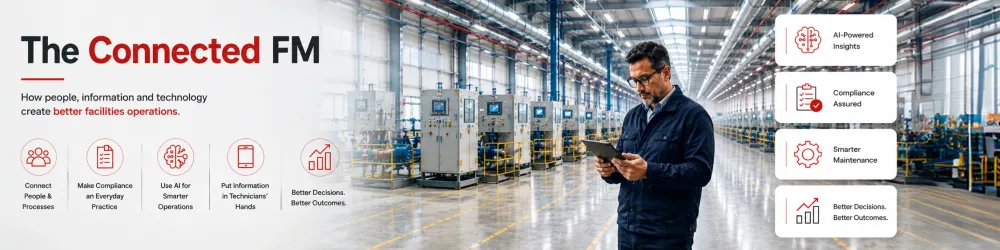
The Connected FM
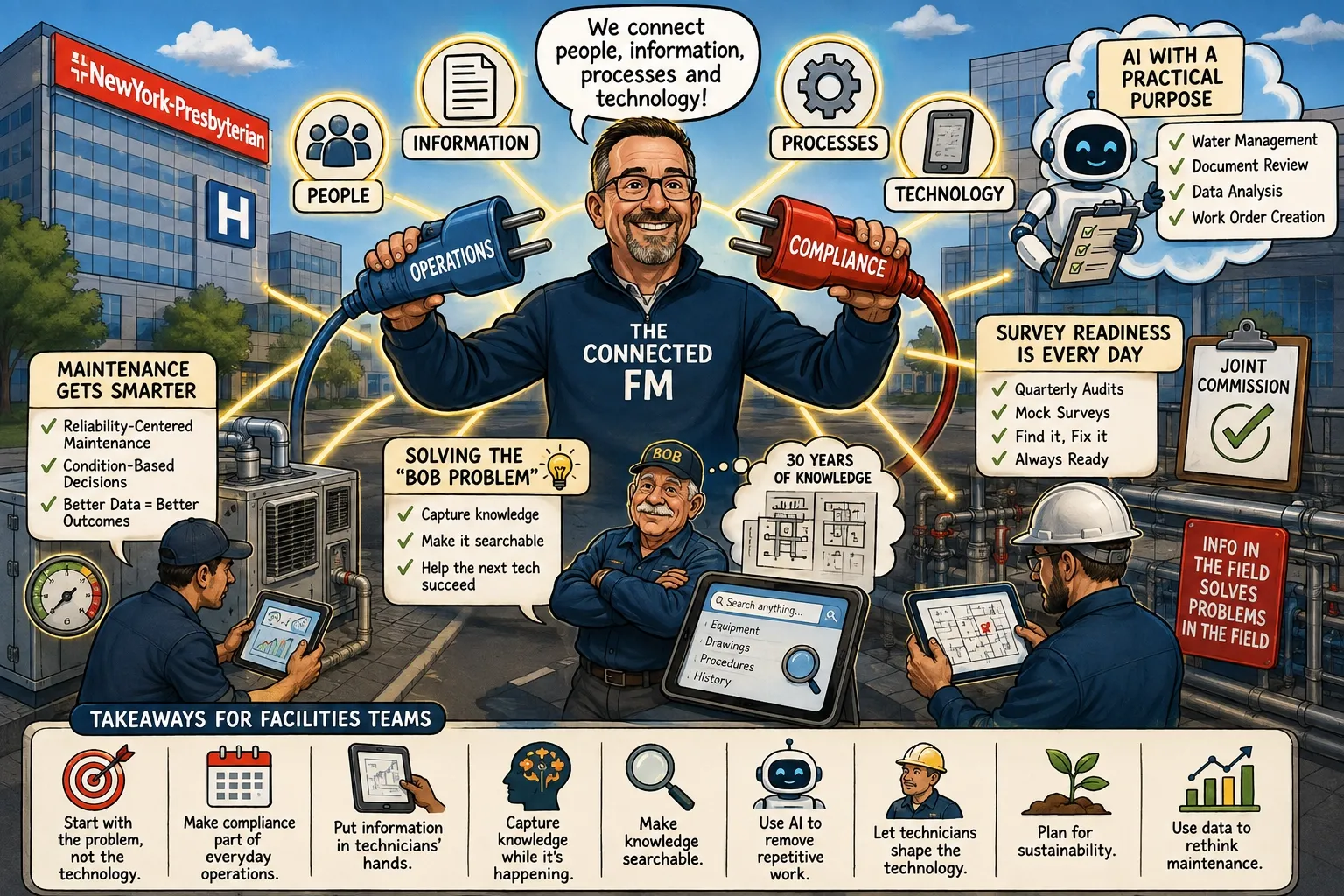
Frank Rudilosso, Senior Director of Maintenance Operations Programs at NewYork-Presbyterian Hospital, shared how his career in fire protection, life safety, facilities operations and compliance shaped his approach to managing complex healthcare facilities.
His central theme: better facilities operations come from connecting people, information, processes and technology.
Connecting Operations and Compliance
Frank described his role as the “glue” between facilities operations and compliance. Operations keeps buildings running, while compliance ensures inspections, testing, maintenance and documentation meet regulatory requirements.
At NewYork-Presbyterian, eight facilities compliance coordinators and a manager help standardize documentation and processes across 11 hospitals.
AI With a Practical Purpose
Frank isn't interested in AI simply because it's the latest technology. His team is looking for ways to remove manual steps and improve decision-making.
One example is water management. AI is being trained to read lab results, identify triggers and eventually generate work orders automatically. They're also investigating AI for inspection and maintenance records, document review, data analysis and capturing institutional knowledge.
The philosophy is straightforward: AI should enhance the work people do, not replace them.
Maintenance Becomes More Data-Driven
NewYork-Presbyterian is also implementing Reliability-Centered Maintenance, starting with air-handling units.
Instead of relying solely on fixed schedules, teams can consider equipment condition, criticality and actual performance. Filter changes, for example, can be based on differential pressure rather than simply a calendar.
Vibration analysis and other condition-based approaches are being introduced as the program expands.
Survey Readiness Is Every Day
Frank's approach to Joint Commission readiness is equally practical: don't prepare for the survey—be ready every day. Quarterly audits, mock surveys, standardized forms, documentation reviews, vendor oversight and "find it, fix it" programs help make readiness part of normal operations.
Solving the “Bob Problem”
The conversation also tackled the experienced technician who knows the building inside and out—but carries much of that knowledge in his head. Frank acknowledged that capturing this knowledge remains a work in progress. The goal isn't simply to record it, but to make it searchable and useful to the next technician.
That's where mobile technology and AI will play an increasingly important role.
NewYork-Presbyterian has equipped technicians with iPads for roughly 10–15 years, giving them drawings, work orders, documentation and field-markup capabilities where the work happens.
Takeaways for Facilities Teams
- Start with the problem, not the technology. Identify what needs improvement before choosing AI.
- Make compliance part of everyday operations. Continuous readiness beats a last-minute survey scramble.
- Put information in technicians' hands. The best information is useful where the work is happening.
- Capture knowledge while it's happening. Don't wait until an experienced technician is preparing to retire.
- Make knowledge searchable. Documentation only helps if the next person can actually find and use it.
- Use AI to remove repetitive work. Document review, report analysis and work-order creation are practical starting points.
- Let technicians shape the technology. Field teams often see applications leadership doesn't.
- Plan for sustainability. Every new technology needs an owner, a process and a reason to remain useful.
- Use data to rethink maintenance. Condition-based approaches can help teams spend limited resources more effectively.
The Bigger Idea
Frank's approach isn't really about any single technology. It's about creating a facilities operation where information is standardized, current, available in the field and useful to the people making decisions.
Want to hear more from facilities leaders like Frank? Tune into Facilities Voices for conversations with professionals sharing real-world lessons, strategies, and ideas from the front lines of facility management.
ARC Facilities helps organizations put many of these proactive practices into action by bringing critical building information, equipment details, documentation, and operational knowledge together in one place, helping facilities teams spend less time searching and more time solving problems.