
Risk Management and Facility Management: Two Teams, One Building
Risk managers and facilities teams may sit in different departments, work from different priorities and speak different languages. But they have one thing in common: the building. That’s where their worlds overlap and where working together makes a real difference.
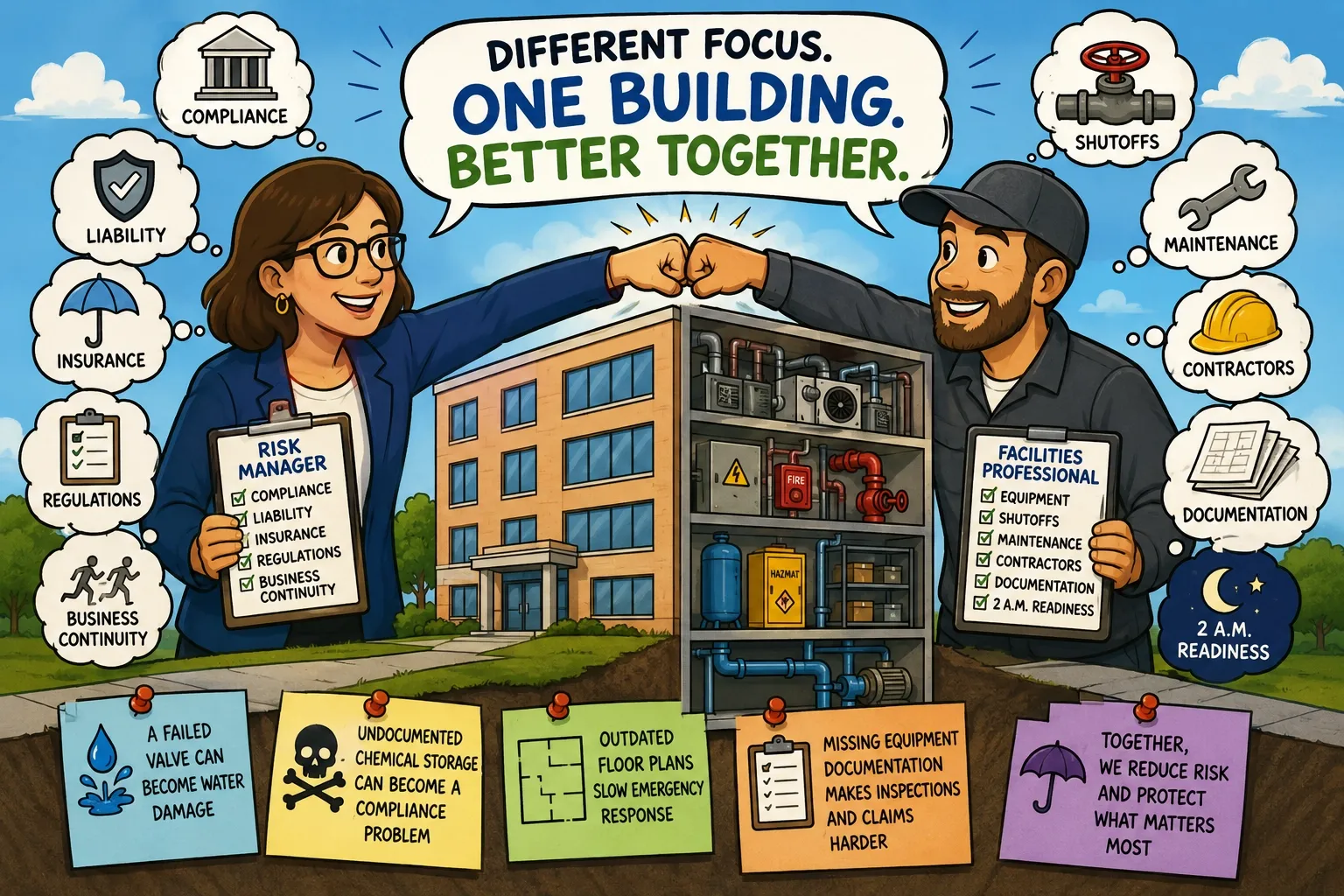
A risk manager may be thinking about compliance, liability, insurance, regulatory requirements and business continuity. A facilities professional is thinking about equipment, shutoffs, maintenance, contractors, documentation and what happens when something breaks at 2 a.m.
Those aren't separate concerns. A failed valve can become water damage. An undocumented chemical storage area can become a compliance problem. An outdated floor plan can slow an emergency response. Missing equipment documentation can make inspections harder and an insurance claim more complicated.
As David Goolsby, an experienced facilities and infrastructure professional put it, “Facility risk isn't a subsection of enterprise risk, it's where a lot of enterprise risk physically lives.”
Look at the Risks Inside the Building
Risk managers don't need to become facilities experts. Facilities teams don't need to become risk managers. They do need a shared understanding of where physical conditions can create organizational exposure.
A useful starting point is:
Where are the biggest facility-related risks that could expose the organization to compliance, safety, or financial problems?
It might include aging mechanical systems, fire protection equipment, electrical infrastructure, hazardous materials, water systems, emergency power, roof conditions or undocumented building modifications. Identifying those risks is only the beginning. The next question is whether the organization can demonstrate that those risks are being managed.
Risk managers bring loss data, regulatory requirements, insurance expectations, and a broader view of organizational exposure. Facilities professionals bring knowledge of the actual building: what is installed, where it is located, what condition it is in and what happens when something fails.
Compliance Isn't Just a Documentation Problem
Preparing for an audit or regulatory inspection often becomes a documentation exercise. Do we have the policy? The inspection record? The maintenance log? The certificate?
Those questions matter. But there's another one:
Does the documentation accurately represent the building today?
Buildings change constantly. Equipment gets replaced. Systems are modified. Construction gets added. Shutoffs change. New drawings arrive. Old equipment disappears. The documentation doesn't always keep up.
A floor plan showing equipment that was removed years ago isn't merely inconvenient. An undocumented shutoff can become an emergency response problem. An outdated asset record can make it harder to demonstrate that required inspections and maintenance are being performed on the right equipment.
For risk managers, the issue becomes especially important when an inspector, accrediting organization or insurance carrier asks for evidence.
The question isn't simply whether a document exists. It's whether the organization can produce current, credible information about the physical condition of the facility.
Can Someone Find What They Need?
Emergency preparedness provides perhaps the clearest example of why risk and facilities should work together. David described spending years mapping shutoffs, documenting equipment, and walking staff to valves and panels so the knowledge wasn't locked in one person's head.
Proof Is Better Than a Checkbox
Risk managers also need confidence that inspections and preventive maintenance are actually happening.
A checklist can show that someone checked a box. It doesn't necessarily show what they saw.
Photo documentation can provide another layer of evidence.
That changes the conversation from “We believe we're prepared” to “Here's what we found, here's when we found it and here's what we did about it.”
Make Risk and Facilities Partners
The best time for risk management and facilities to compare notes is before an emergency or an inspection has gone badly.
Start by asking:
- How prepared are we for the next compliance audit?
- Where are our biggest facility-related risks?
- Can someone respond effectively to a facility emergency?
- Does our documentation match the building?
- Can we prove what we inspected and maintained?
ARC Facilities supports both sides of that conversation by giving facility teams a current, field-ready building record while giving risk managers a clearer picture of the physical assets and documentation behind organizational risk. By bringing plans, equipment information, emergency details, photos and other building information together, ARC Facilities helps both teams before an inspection, during an emergency and throughout the building’s life.