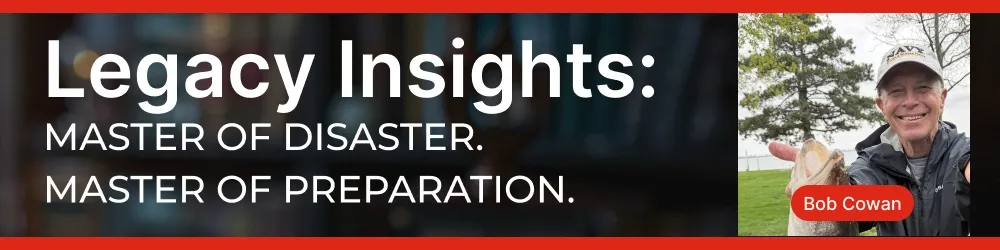
Bob Cowan
Master of Disaster, Master of PreparationAfter 22 years in the Navy and another 22 at Fred Hutchinson Cancer Research Center, Bob Cowan knows that facilities management is about preparing for the unexpected, developing people and knowing when it’s time for a new adventure.
Bob has a simple philosophy about facilities management: “If you don't have a good Plan B, you better have a good resume.”
It's a line he developed during two decades at the Center in Seattle, where a mechanical failure could put priceless scientific research at risk. It also reflects lessons from an earlier Navy career in facilities engineering around the world.
His colleagues eventually gave him a nickname: The Master of Disaster.
An unexpected route into facilities
After graduating from the University of Michigan with a degree in industrial engineering, Bob entered a difficult job market. The oil crisis had hit, and major automakers were laying off engineers.
He decided to join the Navy, hoping to gain experience until the economy improved. He originally wanted to become a nuclear power officer aboard a submarine, but he was colorblind and failed the physical three times.
Instead, the Navy assigned him to the Civil Engineer Corps, responsible for facilities engineering and maintenance. His assignments took him to Guam, Micronesia and Brussels, Belgium. Along the way, he worked for more than a dozen supervisors, some excellent and others considerably less so. One lesson stuck with him: Good leaders support their people when things go wrong, not just when everything goes right.
Protecting priceless research
After leaving the Navy, Bob hoped to pursue something outside facilities. But he eventually joined Fred Hutchinson Cancer Research Center.
During his tenure, the organization grew from approximately 600,000 square feet to nearly 2 million. When he arrived, Fred Hutch had one Nobel Prize winner. When he left, it had three. He jokes that he won't take credit for the Nobel Prizes, but he certainly contributed to the campus's growth.
The research environment brought enormous responsibility. A power failure or refrigeration problem could threaten scientific materials that couldn't be replaced.
Bob and his team regularly reviewed vulnerabilities and developed a contingency-planning book covering 39 emergency scenarios, from freezer failures to power outages.
One memorable example involved a building housing 200 ultra-low-temperature freezers operating at minus 80 degrees Celsius. The campus had approximately 1,200 such freezers.
Although the building had redundant electrical feeders and backup generators, Bob recognized another vulnerability: insufficient air-conditioning if a rooftop air handler failed on a hot day.
Funding for a redundant unit was repeatedly rejected. So his team worked with two vendors to develop an emergency response involving a 30-ton air handler, chiller and generator that could be delivered on a flatbed in less than two hours.
When an air handler eventually failed, the team activated its contingency plan and saved the facility.
Bob describes the situation as a potential “death spiral.” As temperatures rose, freezer compressors worked harder, generating more heat and making the problem worse.
Developing the next generation
Bob also understood that protecting a facility meant investing in its people.
He helped establish an aggressive, paid apprenticeship program with a local union. At its peak, Fred Hutch had five apprentices in a four-year program combining hands-on experience with evening classes.
The program helped address a shortage of licensed boiler operators. Candidates came from outside and inside the organization. He appreciated the opportunity to develop people whose work ethic, communication skills and reliability were already familiar.
He also created planner-scheduler positions to give younger facilities professionals experience working with different supervisors and preparing for management roles. One eventually rose through the organization and replaced Bob when he retired.
It's a fitting legacy for someone who spent decades thinking about institutional knowledge and succession planning.
Knowing when to move on
He described retirement in three stages: the “go-go years,” the “go-slow years” and the “no-go years.”
“I wanted to retire while I was still in my go-go years,” he said.
He's certainly making the most of them. His travels have included Vietnam, Cambodia, Japan, Iceland, Sweden and Canada, along with golf trips with friends. He and his wife also completed her goal of visiting all 50 states before she turned 60. He golfs, fishes and walks a mile and a half daily with his 91-year-old neighbor.
Advice for the next generation
Cowan believes facilities management is an appealing career for people who enjoy solving problems and being where the action is.
“If you don't want to sit behind a desk, if you want to be where the action is, facilities is the place for you,” he said.
But he cautioned that the work is stressful. Budgets are tight, equipment fails and customers expect results. People entering the profession need to learn how to manage that pressure.
Now that he's retired, Cowan may spend more time on golf courses than in mechanical rooms, but his professional philosophy remains unchanged: prepare for the unexpected, invest in your people and protect your assets.
And if things don't go according to plan?
You'd better have a good Plan B.
Want more candid conversations like this? Tune into our Facility Voices Podcast.