What Manufacturing Emergencies Reveal About Documentation
In manufacturing environments, emergencies rarely arrive with a formal warning; instead, they tend to begin with an unfamiliar vibration, an unusual smell, a piece of equipment behaving slightly outside its norm. In those subtle early moments, the difference between a controlled response and a cascading crisis often comes down to one overlooked factor: how quickly the right information can be found and trusted.
Two experienced manufacturing leaders, Karim Desouky, Maintenance and Facilities Senior Manager at BPG, and Nestor Gonzalez, LSSBB, MSc Materials Engineer, spoke about serious incidents they have faced on the plant floor. Their stories made something unmistakably clear: documentation is an operational control that can directly influence safety, downtime, and even survival.
When Production Pressure Delays Escalation
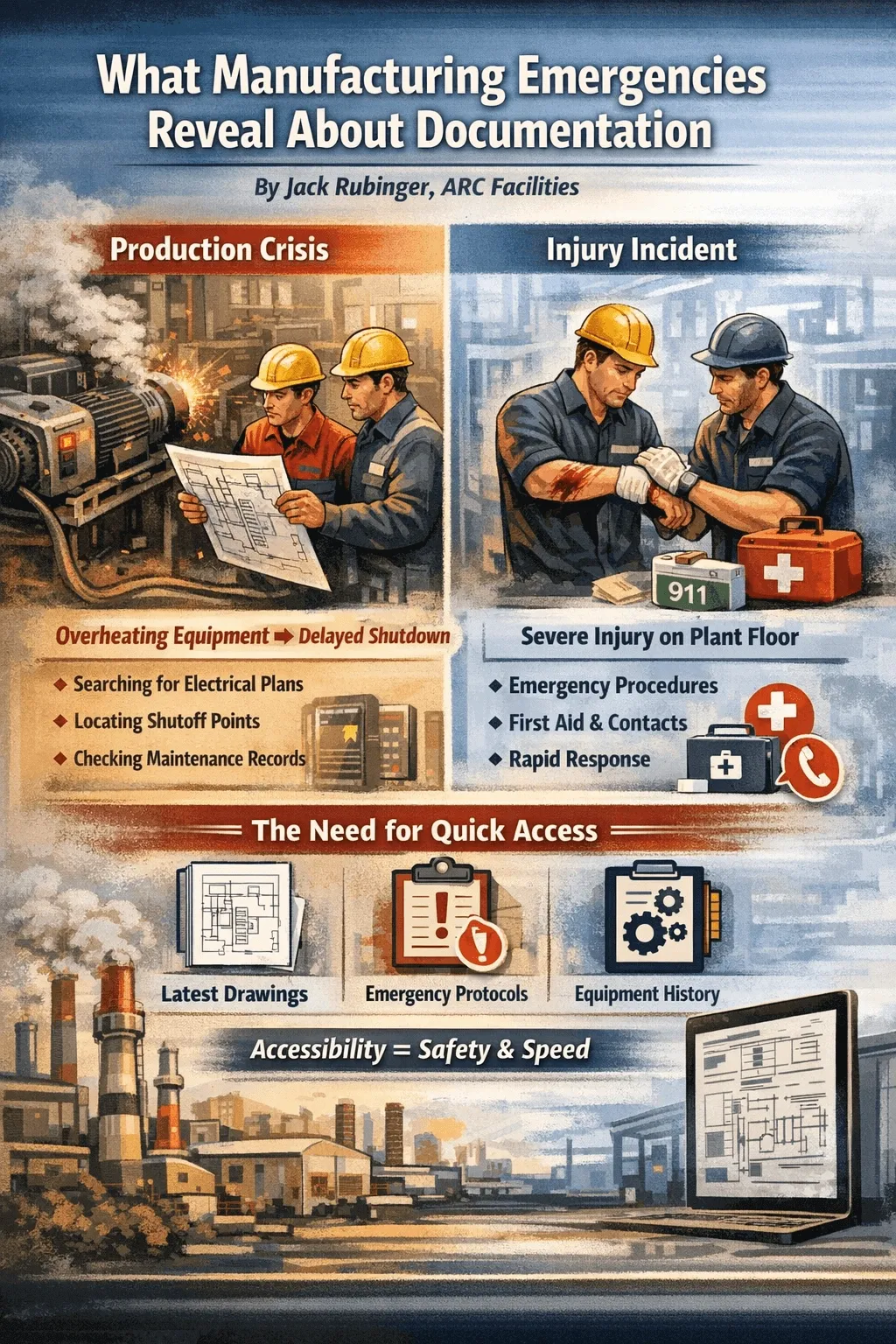
Karim described a significant near-miss involving an overheating conveyor drive and motor in a high-throughput production area, where early warning signs—abnormal noise and the unmistakable scent of something overheating—were initially observed by operators who were simultaneously navigating the relentless pressure to maintain output.
“One significant near-miss I experienced involved an overheating conveyor drive and motor in a high-throughput production area. Operators initially noticed abnormal noise and a burning smell, but production pressure delayed escalation. The situation stabilized once maintenance was called, power was isolated, and the area was secured.”
What caused the situation to edge closer to danger was not a lack of skill or concern, but uncertainty at a critical decision point, where operators were unsure which electrical disconnects controlled that specific section of the line and did not have immediate access to the most current electrical drawings on the floor.
“What made the situation escalate initially was incomplete information at the point of decision — operators weren’t sure which disconnects controlled that specific section, and the latest electrical drawings were not readily available on the floor. Once we accessed the correct documentation and confirmed isolation points, the response became controlled and safe.”
That moment of hesitation—when the team knows something is wrong but cannot immediately confirm how to isolate it safely—is precisely where risk compounds, because uncertainty slows action, and delay allows heat, pressure, or mechanical stress to intensify.
When what information his team needed in those first moments, his answer reflected a disciplined and structured response approach:
“The team immediately needed:
- Correct electrical and mechanical drawings
- Equipment isolation/shutoff locations
- Recent maintenance history on the asset”
The documentation existed, but accessibility was the issue, as critical information was distributed across shared drives, physical binders, and the institutional knowledge of individuals rather than consolidated into a single, reliable source.
“Finding this information was possible, but slower than it should have been because documents were spread across shared drives, binders, and individual knowledge rather than a single source of truth.”
In a manufacturing setting, “possible but slower than it should have been” is not a neutral condition; it is a vulnerability that quietly increases the probability of escalation.
The Predictable Pattern of Emergency Preparedness
When something goes wrong on a plant floor—whether it is mechanical failure, electrical fault, pneumatic issue, or process deviation—experienced teams instinctively search for three categories of information, and Karim outlined them in an order that reflects both safety and operational discipline:
“When something goes wrong on the plant floor, the first three things we typically look for are:
- Safe shutdown and isolation points (electrical, pneumatic, hydraulic, gas)
- Equipment documentation (manuals, drawings, SOPs, emergency procedures)
- Recent work and failure history (prior issues, temporary fixes)”
This sequence is revealing because it begins with containment and stabilization, transitions into technical understanding, and concludes with historical context that can guide troubleshooting and prevent recurrence, creating a structured path from reaction to resolution.
As Karim emphasized:
“Having this information quickly accessible often determines whether an incident stays minor or escalates into a safety or downtime event.”
The difference is not simply whether documentation exists somewhere in the organization; it is whether it can be accessed, verified, and acted upon within seconds rather than minutes.
When the Stakes Turn Personal
While equipment failures threaten productivity and revenue, some incidents carry consequences that extend far beyond downtime, as Nestor’s experience at a whitewares factory powerfully illustrates.
He described what he considers the scariest incident of his career, an accident involving an operator handling a bowl coming off a kiln cart.
“Probably scariest was a major incident to one of our operators at a whitewares factory. Individual picked up a bowl coming out of kiln cart. The bowl was dented and when picked up it split in two pieces. Razor sharp pieces. One of them slid down across his bicep. It sliced a 4” long gash which was about 2” deep. It missed a major artery by 1/2”. He bled for about 5 minutes, I was personally standing on a pool of his blood. Quick response by our team made it possible to sustain him until paramedics arrived.”
In this case, the difference between a severe injury and a fatal outcome was measured in half an inch and a matter of minutes, and the team’s ability to respond effectively depended not on drawings or equipment manuals, but on preparedness, clarity, and immediate access to emergency procedures and trained personnel.
“In this instance, having emergency procedures and emergency contact numbers easily accessible on mobile devices would have accelerated emergency responsiveness,” he said.
Because procedures were established, contact information was readily available, and team members were properly trained, the response was decisive and organized rather than chaotic, allowing them to stabilize the injured operator until paramedics arrived.
Redesigning Documentation for Real-World Conditions
When asked what an ideal documentation system would look like if built from the ground up, Karim described a model rooted in accessibility, integration, and accountability rather than mere storage.
“If I could redesign the documentation process, ‘good’ would mean:
- A centralized, digital system accessible on mobile devices and shop-floor terminals
- Asset-based documentation tied directly to each piece of equipment
- Clearly labeled emergency procedures and isolation diagrams available within seconds
- Regular review and ownership to ensure documents stay current”
This vision acknowledges that in the middle of an emergency, no one has time to search across multiple platforms, log into different systems, or rely on memory to bridge documentation gaps; instead, information must be organized in a way that mirrors how technicians think and how assets are physically arranged on the floor.
As he concluded:
“This would significantly improve safety by reducing hesitation and guesswork, cut downtime by speeding troubleshooting, and improve recovery after incidents by enabling better root cause analysis and learning.”
Documentation as a Control Layer
Across both stories—one involving overheating equipment and another involving a life-threatening injury—a consistent theme emerges: emergencies expose the true condition of your documentation process, revealing whether it functions as a reliable operational control or as a fragmented archive that slows response.
Manufacturing leaders routinely invest in protective guards, interlocks, preventive maintenance programs, and training initiatives, yet documentation itself operates as a critical safety layer that either accelerates confident action or introduces hesitation at the worst possible moment.