
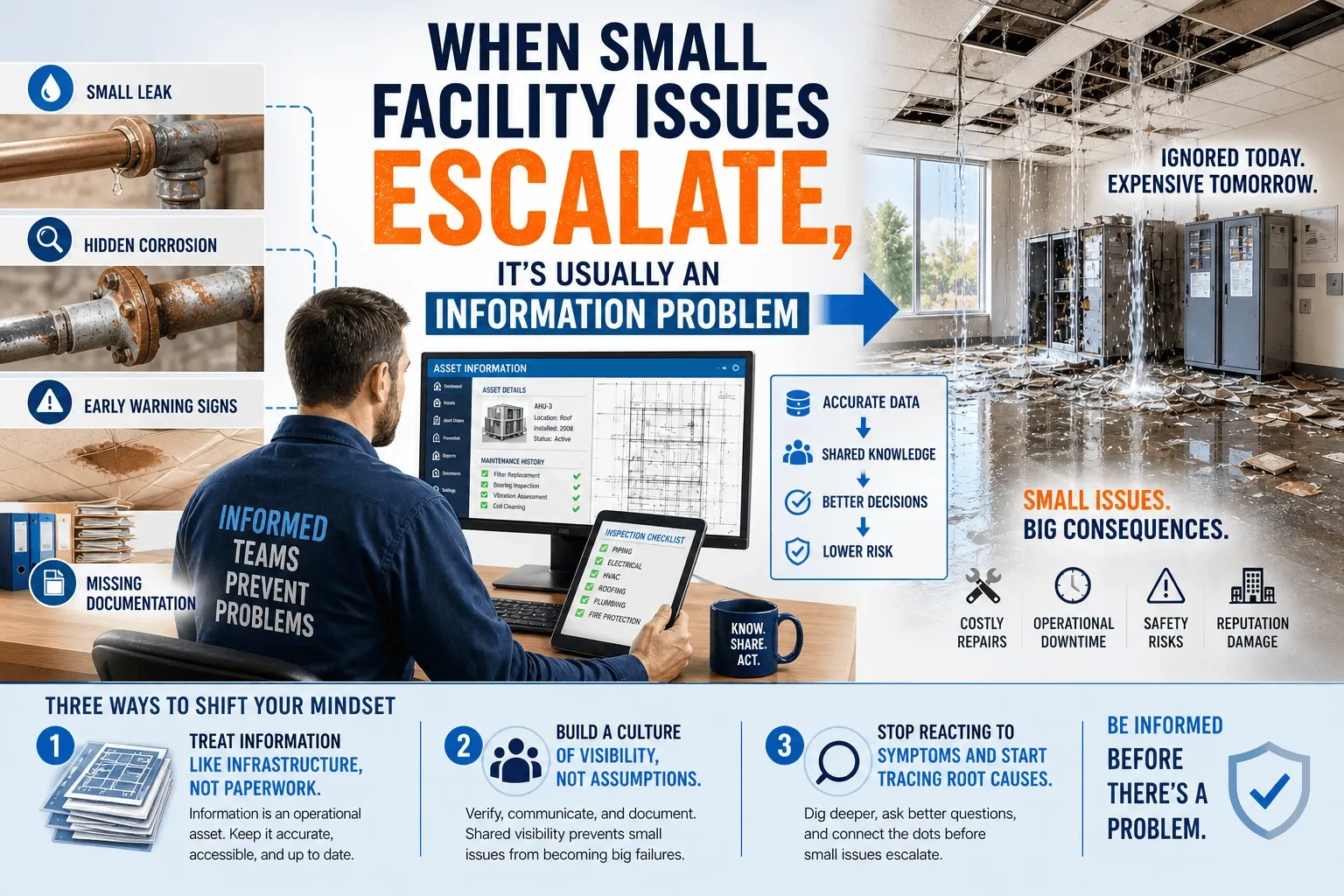
When Small Facility Issues Escalate, It’s Usually an Information Problem
Examples of minor issues turning into major problems at facilities run the gamut from small leaks and temporary repairs to missing documentation and forgotten infrastructure. Things that seem manageable in the moment have a way of escalating quickly. A cracked sewer pipe patched years ago may suddenly fail and flood a building. Concrete that was never sealed properly can allow water to penetrate deep enough to rust the rebar, eventually cracking the structure itself.
It raises an uncomfortable question for facility teams everywhere: why do seemingly minor issues become so expensive and disruptive later on?
Part of the answer is that predicting the future inside complex facilities is never easy, even with technology on our side. Equipment lifespans are estimates. Repairs made years ago are often forgotten. Teams change. Documentation gets misplaced. Sometimes it becomes difficult to remember when something was last inspected or even where it was located in the first place. As a result, facility professionals are constantly watching, wondering, checking, and asking questions. They stay alert because they know firsthand how quickly conditions can change.
But one thing that remains consistent is the importance of sharing knowledge with teams. “Better to overcommunicate than under-communicate,” said Charles Atkinson, Director of Facilities, University of Pikeville.
Water Will Find a Way
“Water intrusion. The leak itself might be small, but the damage spreads like cancer,” said Nick Viola, Director of Facilities, Holden Forests & Gardens.
In healthcare, education, manufacturing, and commercial facilities alike, water intrusion remains one of the clearest examples of how a small issue can quietly intensify over time before revealing itself in a major way.
“Something we recently had a big issue with was lack of dielectric connections at the joining of dissimilar metals. These can go unnoticed for years because they are under insulation but when the corrosion gets bad enough, the pipe will fail,” said Brooke Bohm, Vice President of Facilities, Children’s Health.
Many of these issues stay hidden precisely because they appear insignificant in the beginning. The warning signs are subtle. A stain on a ceiling tile. Minor corrosion under insulation. A small vibration in equipment. An undocumented repair. Individually, they may not trigger alarm bells. Collectively, they create risk that compounds over time.
Data Drives Decisions
"Data is driving everything, everywhere,” said Keith Karamarkovich, Senior Director, Facilities Site Operations, Comcast. “If I had a starting point to chase data, it would be in as-builts and asset inventories. They are the base of the pyramid and the systems manipulating it."
That foundation becomes even more important as facilities age and infrastructure grows more complicated.
“A challenge that is often underestimated but consistently proves to be one of the most consequential is the failure to maintain accurate, living as built documentation,” said Nick DeLucci, Director of Facilities Management, MRA Group “On our campus, we are redeveloping a laboratory and science environment that dates back roughly 60 years. In the current phase, we are installing new underground infrastructure including electric, domestic water, fire protection, storm, and sanitary systems while the campus remains fully occupied. To maintain continuity of operations for existing tenants, legacy utilities must remain live while new systems are brought online. Despite comprehensive due diligence, including surveys and utility scanning, we continue to encounter abandoned and undocumented infrastructure: old telephone lines, duct banks, domestic water services, and process piping that either never made it onto record drawings or were inaccurately captured.”
The common thread throughout these stories is not simply maintenance failure. It is the accumulation of overlooked information. A repair that was never updated on a drawing. A communication breakdown between departments. An asset inventory that slowly became outdated. Small omissions eventually create larger operational consequences.
For facility leaders, this is why documentation and institutional knowledge matter so deeply. They connect the past, present, and future of a building. Without that continuity, teams are left guessing during the moments when certainty matters most.
Constant Costs
Most of these “minor” issues start as a $500–$2K fix, but if they’re ignored, they can easily turn into a $5K–$50K problem once you factor in energy waste, equipment strain, and reactive repairs. In higher-stakes environments like data centers, the impact can be significantly higher.
At one facility Adel Bouhabib services as a contractor, they had a leak coming from behind a sub-ceiling one night.
“It didn’t look like much just a slow drip hitting the floor. We’d seen stuff like that before. You put a bucket under it, you make a note, you come back in the morning. That’s the call we made,” he said.
“What we didn’t do was trace it back to where it was actually coming from. That was the mistake. It wasn’t a pipe. It was a water heater that had been building pressure and was already on its way out. And it didn’t wait for morning it let go overnight. We showed up the next day to a completely flooded store. Ceiling materials down, floors soaked, equipment sitting in water. What should have been a service call turned into a full restoration. The cleanup alone took days. The cost? Way more than it should have ever been,” he added.
“The hardest part is it was preventable. If someone had taken 10 extra minutes that night to trace the leak back to its source, we would have seen the water heater. We would have shut it down. That’s it. That’s all it would have taken. But when something looks minor, your instinct is to manage it and move on. Nobody wants to make a big deal out of a drip. The drip was a symptom not the problem. That night taught me: unknown source means unknown risk. You don’t get to assume it’s fine just because it looks fine.”
This isn’t just a maintenance issue, it’s an information issue. Fortunately, we’ve seen that information, awareness and action can help change the course of these events. It’s a matter of shifting your thinking about how to operate. Don’t be the team that still digs for information. Be the team that’s informed BEFORE there’s a problem.
Three ways you can shift your mindset:
Treat information like infrastructure, not paperwork.
Facility information should be viewed the same way you view critical building systems. Drawings, asset histories, shutdown procedures, repair records, and emergency documentation are operational tools that directly affect safety, response time, and decision-making. When information is outdated, scattered, or difficult to locate, small problems gain time to grow.
Build a culture of visibility, not assumptions.
Many major failures happen because someone assumed a repair was completed properly, an asset was documented correctly, or another department already handled the issue. High-performing facility teams create habits around verification, communication, and shared visibility. They document temporary fixes, update records consistently, and make sure critical knowledge does not live only inside one person’s memory.
Stop reacting to symptoms and start tracing root causes.
A leak, vibration, alarm, or hot spot is rarely the real problem. It is usually the warning sign of something larger developing behind the scenes. The most effective facility teams train themselves to investigate beyond the immediate symptom by asking better questions, reviewing historical information, and understanding how systems connect before a small issue escalates into operational disruption.