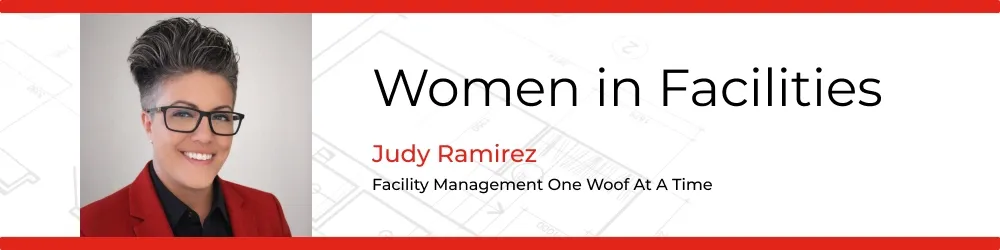
Facility Management One Woof At A Time
What is it like to manage a pet hotel?
Do the guests get room service? Are the rooms big enough to play catch? Is the mini-bar stocked with kibble?
Probably not. But when your hotel is home to nearly 200 dogs at full capacity, one thing is certain: something is always breaking.
For Judy Ramirez, that was her introduction to facilities management, even though she didn't realize it at the time.
"I wanted to be a veterinarian," she said. "But I'm really bad at math, so I couldn't pass calculus."
Instead, she followed her love of animals to PetSmart, where she eventually managed one of the company's facilities. On busy days there could be 184 dogs under one roof, creating a nonstop parade of clogged drains, damaged doors, chewed-up fixtures, and maintenance emergencies.
"I became intimately familiar with how important maintenance and repairs are," Judy said. "Although that was never my goal."
Like so many people in the profession, facilities wasn't part of her career plan.
After graduating from college, she hoped to move into PetSmart's corporate office. The timing couldn't have been worse. So she kept applying. About a year later, one opening caught her attention: Facilities Project Manager.
"I'd never heard of facilities before," she laughed. "But I knew the stores very intimately. I thought, 'This sounds kind of cool. You're like the firefighter. You get called when there's an emergency.'"
That description fit her perfectly. She had always been comfortable in high-pressure situations, and before long she discovered she'd found a career she genuinely loved.
"Much like my peers," she said, "nobody ever starts out saying they want to be a facilities manager when they grow up."
What keeps Judy excited today is that no two days are alike. "I think the most surprising thing is every day is different," she stated. "If I had a job where I did the same thing every day, like data entry, I'd be bored out of my mind." It's the variety and the complexity that still amazes her.
"A situation will come up, and I know exactly what to do. Then I almost listen to myself from outside my body and think, 'How do I even know this stuff?'" She laughed at the thought. "When did I become an expert in HVAC components?"
In facilities management, expertise doesn't arrive all at once. It accumulates one emergency, one repair, one project, and one problem at a time until, almost without noticing, you're the person everyone turns to when something goes wrong. And in an industry that mostly male-dominated, Judy appreciates working with an all-women team at her current organization. “In the ten years, I’ve been going to industry conferences, I’ve seen more diversity. A lot more young people, and that makes sense because we must leverage more technology, be faster, and adjust to a world is changing.”
Earlier in her career, she worked at organizations that were predominantly all men, and she had to work three times harder than her peers just because she was a woman. The perception was like, “Oh, she wouldn’t know anything about engineering or maintenance or the dirty stuff.”
But Judy was a quick learner, and she thrived on dealing with complexities. “Now, industry leaders are saying that we need more people with technical knowledge and technical expertise.”
Judy explained that in facility management, you’ve got to wear multiple hats and adjust your approach to the situation and the many personalities you encounter every day. Judy recalled working with Jim, a whose 20+ years of experience and no BS communication style were useful. “He was a true subject matter expert, but I also know that technical knowledge alone isn’t always enough when you’re in a leadership position.”
“We're project managers, crisis managers, and vendor managers all at once,” she said. “One minute we're talking someone through a flooded or burning store. The next, we're coordinating vendors with empathy while keeping everything moving.”
As Judy gets more seasoned, she doesn’t mince words when the subject turns to the future of recruiting.
“You hire for personality and you teach skill because there are certain things you can’t train into somebody,” she said. “I’m always looking for a human that’s got all the right building blocks. And then from there, we help them grow, but that takes time, dedication, training, and support. Unfortunately, a lot of times FMs get thrown into roles and there’s no mentor, no manager. It’s sink or swim.”
She also sees AI helping attract the younger generation of talent who want to examine things at a micro level and answers really quickly without fast with relying on Jim or Bob for help. “There’s a whole generation that trust technology is here to help us, not replace us,” she said.
Offering career advice, Judy explained, “Focus on your personal brand and your professional network. Build relationships, stay visible, and invest in your reputation because the people you meet today are often the ones who open the door to your next opportunity.”