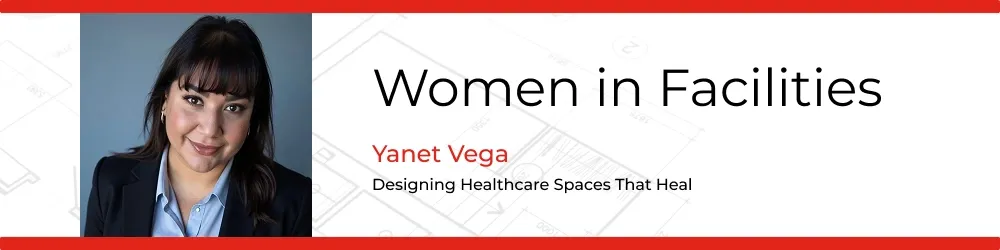
Yanet Vega
Designing Spaces That HealTeachers, parents, friends all often speak of the value of an education, but few prepare graduates for the "second education" that begins on the job. So you wind up educating yourself. And really, self-education might be the most meaningful and long-lasting kind.
For Yanet Vega, that lesson came early. After graduating with a degree in architecture and entering the design world, she realized that a building’s story doesn't end when the blueprints are filed. It truly begins when the doors open.
“I was a new graduate expected to do projects from beginning to end, without the mentorship I needed. It quickly became clear that it wasn’t the right job for me.” Yanet recalled.
So she did what a lot of smart, resourceful people do when they hit a wall. She started researching.
She jumped on LinkedIn and Google. Looked up classmates who graduated ahead of her. Studying their job titles, she discovered that an architecture degree isn't a narrow path, it’s a foundation for a million directions, leading her to a pivotal role at El Rio Health.
That move right there? That’s the kind of thing nobody tells you in school.
And maybe they can’t. You’re talking to people who already made it through. But still, it’s rare to hear, while you’re in school, what your training can realistically turn into. There’s no straight line. It’s one main line and ten more branching off from it.
At El Rio Health, she found something that clicked.
“They explained how they were one of the largest Federal Qualified Health Centers (FQHC) in the nation, serving over 130,000 lives. Serving diverse members of the community from every social, cultural, and economic background. And that really resonated with me,” she said.
She also did something else most people aren’t taught to do early in their careers—ask classmates about pay.
“When I touched base with what they were doing, I asked what pay range they were receiving out of school with no experience. That way when I interviewed, I had a better understanding of what salary to ask for. That’s something nobody talks about in school. People just don’t openly discuss pay,” she added.
Yanet’s transition into Facilities Leadership wasn't a career change; it was a strategic pivot. She recognized that the built environment has a profound impact on community health and organizational return of investment. Today, she oversees the full lifecycle of more than 20 facilities and counting, from ground-up construction and interior design to aesthetic selections, long-term sustainability, and infrastructure resilience.
She thinks a lot about “how users in the space use the building.”
What she finds most gratifying is seeing how space affects an entire population in Tucson, Arizona. “In healthcare, the facility is a ‘one-stop-shop’ for the community’s well-being. Walking into a finished building for me is like seeing a drawing come to life, but with the added responsibility of ensuring that life-cycle remains sustainable for the next 20 years.”
You don’t see a lot of women in the trades. Yanet noticed. And she makes a point to pause and talk with young women who are curious about these careers.
She’s also giving back by speaking to students at University of Arizona and getting involved with CREW Network. She is mentoring the next generation of women in the trades. She wants them to see that Facilities is no longer a "back-office" function; it is a critical leadership discipline that requires a blend of technical mastery, financial acumen, and empathy.
This passion for the built environment isn't contained within the office walls. Outside of work, Yanet and her daughter connect through a shared love of architecture. On vacations to the Caribbean, Australia, Asia, Europe and other parts of the world, they don’t just sightsee; they explore historic structures together, decoding the DNA of how different cultures build and live.
This connection to the industry is becoming a family legacy, although through different lenses. While Yanet ensures the structural and operational integrity of healthcare environments, her daughter plans to enter the nursing profession continuing the family’s dedication to healthcare by providing the human care that happens within the walls Yanet maintains.
To the casual observer, facilities management might look like maintenance. To an executive leader, it is Risk Mitigation and Asset Preservation. While Yanet manages a standard schedule, she is the guardian of systems that never sleep. From critical HVAC failures and lighting systems to complex plumbing and emergency evacuations, she oversees the vital organs of the enterprise.
Her architectural lens allows her to see beyond the immediate fix. She approaches every challenge with an eye toward total cost of ownership and user experience. She isn't just maintaining a building; she is optimizing an environment where people work, receive care, and thrive.
As a woman in a traditionally male-dominated field, Yanet is familiar with the assumptions that come with the territory. "Sometimes men assume you don't know the technical details until you answer with authority," she notes.
She lets her work do the talking.
Yanet’s story isn’t about following a perfect plan. It’s about paying attention, asking better questions, and being willing to research your way into a future that fits.
Which, in a lot of ways, might be exactly what education is supposed to prepare you for: not just to follow a plan, but to have the tools to build a better one.