The State of Healthcare Facility Operations
The Operational Risks Reshaping Healthcare FacilitiesExecutive Summary
Healthcare facility teams are under growing pressure to maintain operational continuity inside increasingly complex environments.
But across hospitals and health systems, many organizations are encountering the same problems:
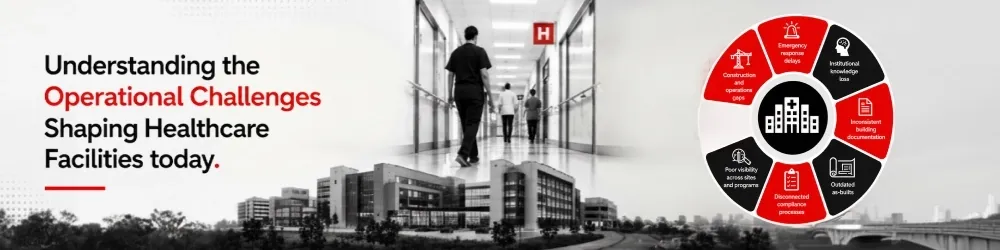
- Emergency response delays
- Institutional knowledge loss
- Inconsistent building documentation
- Outdated as-builts
- Disconnected compliance processes
- Poor visibility across sites and programs
- Construction and operations gaps
Individually, these may appear manageable.
Collectively, they create response vulnerabilities that affect readiness, maintenance efficiency, compliance, infrastructure planning, and day-to-day operations.
This report examines the operational themes appearing most frequently in conversations with healthcare organizations and explores what they reveal about the current state of healthcare facility operations.
What’s Happening Now
Healthcare facilities are not simply dealing with maintenance challenges. They are managing growing operational complexity with incomplete visibility into the buildings they operate.
That complexity becomes most visible during:
- Emergencies
- Infrastructure failures
- Renovations
- Compliance events
- Staff turnover
- After-hours response situations
The organizations responding most effectively are treating facility information and operational visibility as infrastructure, not administrative overhead.
Emergency Readiness Is An Operational Priority
One of the clearest themes emerging across healthcare organizations is concern around emergency response readiness.
Many facility teams report difficulty quickly confirming:
- Shutoff locations
- Infrastructure details
- Emergency procedures
- Renovation history
- Accurate field conditions
During critical situations, delays are often caused less by technical capability and more by uncertainty.
The first minutes of an emergency frequently reveal response vulnerabilities that already existed long before the event itself.
Institutional Knowledge Is Leaving Faster Than Organizations Can Replace It
A repeated concern across healthcare systems is dependency on long-tenured employees who understand how buildings actually function.
In many organizations:
- Critical building knowledge lives with a handful of experienced staff
- Newer technicians struggle to access historical system knowledge
- Retirement and turnover are increasing operational uncertainty
- Teams are relying heavily on memory during emergencies and troubleshooting
This issue extends beyond staffing. It represents a growing continuity risk for healthcare operations.
Strategic Insight
Organizations are realizing that undocumented building knowledge creates long-term response vulnerabilities.
Healthcare Systems Are Struggling With Inconsistent Building Information
Many healthcare organizations report that building documentation no longer reflects actual field conditions.
Examples include:
- Outdated as-builts
- Missing renovation history
- Inconsistent standards between facilities
- Incomplete closeout documentation
- Uncertainty around infrastructure changes over time
The result is slower troubleshooting, increased project friction, and difficulty planning infrastructure work confidently. For multi-site health systems, the issue becomes even harder to manage because information quality often varies significantly between campuses.
Compliance Visibility Remains Fragmented
Compliance tracking continues to be a major operational challenge for healthcare facility teams. Organizations report difficulty managing:
- Inspections
- Risk assessments
- Corrective actions
- Policies
- Documentation requirements
- Audit preparation
In many systems, teams still lack a centralized operational view across facilities, programs, and compliance activities. This creates both administrative burden and operations risks.
Key Observation
Healthcare organizations increasingly want visibility into:
- What’s complete
- What’s overdue
- What’s missing
- Where operational risk is growing
Construction Handoffs Continue To Create Long-Term Operational Problems
Another recurring theme is frustration around the disconnect between construction teams and facility operations.
Healthcare organizations describe challenges involving:
- Incomplete project closeouts
- Inconsistent turnover documentation
- Inaccessible renovation history
- Poor integration between design data and field operations
- BIM information that is difficult to use operationally
Many facility teams feel they inherit buildings without inheriting usable operational knowledge.
Budget Pressure Is Changing How Projects Are Evaluated
Even organizations that recognize these operational issues often face budget pressure and internal justification hurdles. This is changing how healthcare leaders evaluate facility technology and operational investments.
Increasingly, projects must demonstrate impact on:
- Emergency readiness
- Labor productivity
- Downtime reduction
- Compliance visibility
- Infrastructure planning
- Risk reduction
The conversation is shifting away from digitization alone and toward operational resilience.
Real-World Themes Emerging Across Healthcare Organizations
Common themes appearing in healthcare facility discussions include:
Emergency Readiness
- uncertainty around shutoffs and emergency assets
- delayed response during urgent situations
- inconsistent access to infrastructure information
Building Knowledge Loss
- dependency on long-tenured staff
- retirement concerns
- limited knowledge transfer between teams
Documentation Problems
- inaccurate as-builts
- inconsistent site standards
- disconnected renovation history
- redraw costs and duplicated work
Compliance Challenges
- siloed compliance processes
- reactive tracking methods
- poor visibility across programs and facilities
Operational Visibility
- lack of centralized oversight
- inconsistent data between locations
- limited insight into infrastructure readiness
What Leading Healthcare Organizations Are Prioritizing Next
Healthcare facility operations are becoming more data-dependent, more cross-functional, and more operationally complex.
Organizations that improve readiness over the next several years will likely focus on:
- reducing response vulnerabilities
- preserving institutional knowledge
- improving infrastructure visibility
- standardizing facility information
- connecting construction history to operations
- improving field access to critical building information
- creating clearer operational oversight across facilities
The broader shift is not simply digital transformation.
It is operational readiness transformation.
The future of healthcare facility operations will depend on how quickly organizations can reduce uncertainty during critical moments.