The State of Facilities Risk
Perspectives from Industry LeadersWhen more than 60 facilities professionals completed a voluntary survey, the results revealed a snapshot of the current operational climate across campuses. Their answers demonstrated consistent patterns around three critical themes: when facilities teams are brought into projects, how confident they feel about turnover documentation, and whether information gaps are creating real-world operational impact.
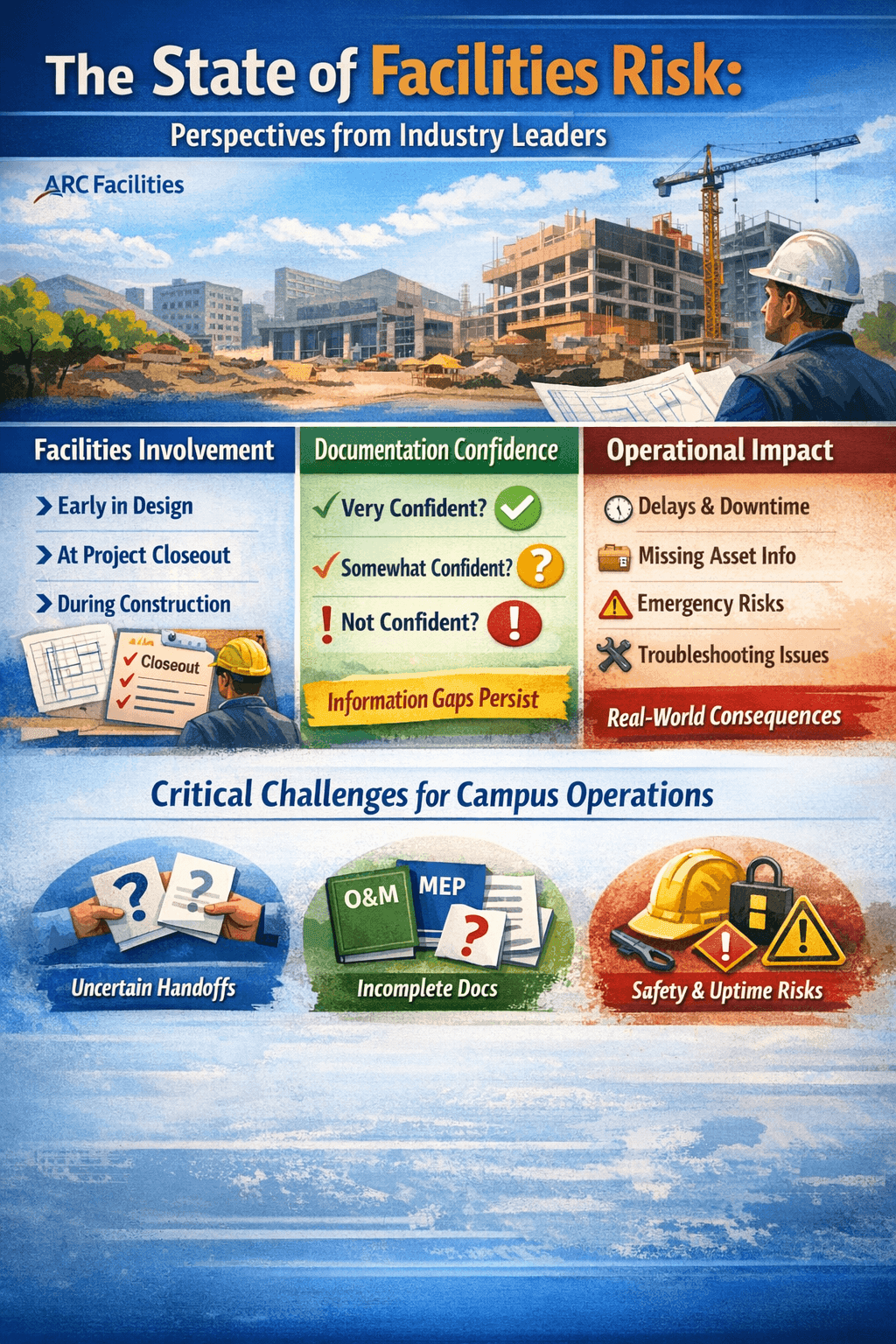
Facilities Involvement: Progress, But Not Consistency
When asked how involved their facilities teams are during design and construction phases:
- A majority reported being very involved from early design.
- A meaningful segment indicated they are brought in primarily at project closeout.
- Others reported involvement during construction only.
- A smaller percentage described minimal or no involvement, or were unsure.
While it is encouraging that early involvement is common, a substantial minority of institutions still engage facilities teams late in the process. That timing gap is significant. When teams inherit buildings after key design decisions are made, they also inherit documentation practices, asset tagging approaches, and system organization decisions they did not shape.
Early involvement reduces surprises. Late involvement often increases them.
Confidence in Turnover Documentation: A Clear Tension
When asked about confidence in receiving complete and usable documentation at turnover—MEP drawings, shutoffs, asset locations, O&M manuals—the responses reveal a pronounced lack of certainty:
- Only a small group reported being very confident that documentation is complete and accessible.
- The largest segment described themselves as somewhat confident—but aware of gaps.
- A significant portion reported being not very confident or not confident at all.
- A few selected not applicable.
The most telling takeaway is that full confidence is the exception, not the norm. Even among teams highly involved in early design, documentation gaps persist. That suggests the issue is not solely about timing of involvement; it is also about how information is captured, organized, and handed off.
Documentation may exist. Accessibility and usability are separate questions.
Operational Impact: Not Hypothetical
Perhaps the most important question asked whether incomplete documentation or missing asset information had caused operational delays, downtime, or safety concerns in the past 12 months.
The majority of respondents answered yes, with many reporting minor impact and a notable percentage reporting significant impact. Others selected “No—but it’s a concern,” indicating awareness of vulnerability even if disruption has not yet occurred. A smaller group reported no issue or were unsure.
This is not a theoretical conversation about best practices. For most respondents, documentation gaps have already translated into real-world consequences.
Operational impact does not always present as a catastrophic failure. More often, it appears as:
- Extended troubleshooting time.
- Delayed repairs due to missing asset details.
- Uncertainty about shutoff locations.
- Increased risk exposure during emergency response.
- Downtime that could have been avoided with faster access to information.
One missing document rarely affects only one person. A delay experienced by a technician can impact supervisors, leadership, safety teams, and occupants. Information gaps create shared friction across roles.
Patterns Across the Data
When the responses are viewed collectively, several patterns emerge:
- Early involvement improves alignment but does not guarantee documentation confidence. Even highly engaged facilities teams report gaps.
- Documentation confidence correlates with operational impact. Institutions reporting low confidence frequently report delays or disruptions.
- Concern exists even where impact has not yet occurred. Many who selected “No—but it’s a concern” recognize vulnerability before it becomes a crisis.
- The issue is systemic, not isolated. The consistency of responses across dozens of institutions suggests this is not a campus-specific anomaly but an industry-wide tension.
What This Means for Campus Operations
Facilities teams operate in environments that demand speed, clarity, and coordination. Buildings are complex, layered systems, and the information that supports them must be equally accessible. When documentation is incomplete, delayed, or difficult to retrieve, the result is not merely inconvenience—it is compounded operational risk.
Turnover should represent a transfer of confidence. Instead, for many institutions, it represents a transfer of uncertainty.
The survey results make one thing clear: documentation practices and information accessibility remain a critical operational pressure point. While many campuses are improving early involvement in design, the handoff between construction and operations continues to present challenges.
For leaders responsible for campus safety, uptime, and performance, the question is no longer whether documentation gaps matter. The majority have already felt their impact.