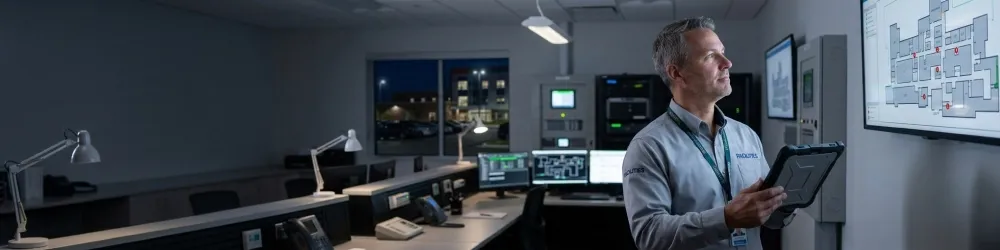
The Night Shift Reality
Why Healthcare Emergencies Demand Instant Access to InformationWhen the lights dim and the city sleeps, hospitals pulse with activity.
After midnight, healthcare facilities enter a different operational reality. Staffing levels shift. Patient needs change. Community resources may be slower to respond. And when something breaks—an air handler, a medical gas line, a critical electrical component—the margin for error disappears.
That’s why emergency preparedness at night isn’t just about having a plan. It’s about having the right people, the right processes, and the right information—instantly accessible when it matters most.
Michele Mucia of Jensen Hughes shared insights on what makes healthcare facility emergency management effective after hours. Her perspective underscores just how different nighttime operations can be—and why preparation must extend far beyond business hours.
24/7 Staffing and Structured Readiness
Emergencies don’t check the clock before happening. Michele emphasized that hospitals must plan accordingly.
Designated emergency response teams and 24/7 planning are foundational to readiness. Even when staffing is reduced overnight, there must be clarity around who responds, who makes decisions, and how communication flows.
“In a constant 24/7 hospital environment, emergency management in hospitals is key. Nighttime operations often differ from daytime operations in that you have reduced staffing, lower patient volume and more challenging patient needs,” she said. “While the core triage and treatment processes remain the same, hospitals often shift to a ‘Hospital at Night’ model, relying on specialized staff.”
That shift requires precision. With fewer people in the building, every role carries more weight. Decision-making must be faster. And access to accurate building information becomes even more critical.
Community Support and Full Evacuation Planning
After midnight, outside help may not arrive as quickly as it does during the day. That’s why community integration is a core component of resilience.
“Access to emergency services, such as local fire departments, community repair vendor, and other neighboring health systems for both hazard, medical supplies, and worst-case full building evacuation planning is crucial,” she said.
True emergency preparedness means building relationships before disaster strikes. It means aligning plans with local fire departments, confirming vendor availability, and preparing for worst-case scenarios—including full building evacuation. And it means ensuring that evacuation routes, shutoff points, and life-safety systems are clearly documented and easy to locate under pressure.
When minutes matter, searching for outdated drawings or incomplete binders simply isn’t an option.
Heightened Safety and Security Risks
Night brings its own set of clinical and security challenges.
“Some studies suggest that weekends face a higher risk of emergencies at night compared to that of day. From a security perspective you can proactively plan by investing in cameras, controlled egress, security staffing, lighting, and intruder training to prepare for unforeseen criminal events,” said Michele. “Night shifts often see a higher volume of alcohol/drug-related cases, psychiatric emergencies, and severe trauma (gunshots, car accidents). It is critical to have a security plan in place to address the challenges that could accompany these situations.”
Many Emergency Rooms now incorporate strict security protocols, including metal detectors and on-site security personnel. But security infrastructure alone isn’t enough. Risk assessments must be tailored to the specific healthcare facility and aligned with CMS requirements and accreditation standards.
From a facilities standpoint, that also means ensuring cameras, access control systems, and lighting infrastructure are maintained, tested, and shut-offs are clearly documented. When a camera feed fails or a controlled egress system malfunctions after midnight, facilities teams must know exactly where to go and what to shut down without hesitation.
Emergency Codes and High-Risk Equipment
Clinical emergencies are only part of the equation. Building systems can be just as life-critical.
“Make sure that in-house staff are trained to manage emergencies like cardiac arrests (‘Code Blue’) and rely on on-call specialists if in-house doctors are not available. The same measures should pertain to a facilities response to high-risk MEP equipment that could create serious risks to life or compromise the integrity of the facility’s physical health and even create great legal repercussions,” she said.
Mechanical, electrical, and plumbing (MEP) failures don’t politely wait for daylight. A failed generator, a compromised medical gas system, or an HVAC issue in an isolation room can escalate quickly. Teams need immediate access to shutoff locations, panel schedules, equipment manuals, and emergency contacts.
This is where documentation becomes a life-safety tool.
The Information You Need—Right Now
In speaking with facility leaders, a few recurring questions define successful overnight response:
- Can you walk through a real after-hours equipment failure and pinpoint what made the difference between quick recovery and prolonged disruption?
- When something breaks after midnight, what information must be in hand to troubleshoot or safely isolate systems?
- How does the quality and accessibility of your documentation affect response time and outcomes?
The answers consistently point to the same reality: speed depends on visibility.
When building plans, O&Ms, shutoff maps, and emergency procedures are centralized and accessible from a mobile device, teams move faster and safer. They don’t waste time digging through file cabinets or calling multiple people to locate a valve. They don’t guess which breaker feeds a critical area. They act with confidence.
That’s where ARC Facilities supports healthcare organizations in strengthening emergency preparedness. By organizing, digitizing, and mapping critical building information into a single, mobile-accessible platform, ARC Facilities ensures that when something fails at 2:13 a.m., the response isn’t delayed by missing information.
Emergency preparedness isn’t just about drills and binders. It’s about actionable intelligence in the moment of crisis.
As Michele made clear, hospitals operating overnight face reduced staffing, heightened security risks, and complex patient needs. “To ensure readiness at night or 24/7, hospitals need a structured and practiced plan that provides clear resources and actionable protocols. Plans should ensure that all patients requiring care overnight are identified, and staff are prepared to manage all-hazard emergencies while maintaining a sustainable built environment,” she said.