
Stadiums Run On More Than Steel & Systems
There’s a particular stillness inside a stadium before an event begins. The seats are empty, the concourses quiet, and the building feels oversized for the moment. Then, almost all at once, everything changes. Systems wake up. People arrive. Loads spike. Expectations rise.
For facility teams, that transition isn’t dramatic—it’s routine. But it’s also where the cracks tend to show.
Stadiums operate in extremes. Long periods of inactivity are followed by short windows of intense demand. Mechanical systems that sit quietly for days or weeks are suddenly expected to perform without hesitation. Access control, lighting, life safety, concessions, and utilities all have to align on schedule. When they don’t, the issue is rarely technology alone. More often, it’s a lack of shared understanding.
“Every event begins weeks before the gates open. We ask questions that sound hypothetical but are treated as inevitable. What if a transformer trips during peak entry? What if a water main fails under the concourse? What if a heat wave pushes cooling systems beyond normal load? What if a sold out crowd overwhelms restrooms, concessions, or egress routes faster than predicted?” said Clint Singleton II, Los Angeles Rams. “What if a storm hits halfway through a game? What if a single component fails and cascades into multiple systems at once? Facilities work is scenario planning disguised as maintenance.”
The Weight of Institutional Knowledge
Most stadiums depend heavily on institutional knowledge. Someone knows which panel feeds a specific concourse. Someone remembers the workaround that only applies during night events. Someone else knows which vendor actually responds on game day.
That knowledge is valuable, but it’s also fragile. It lives in people’s heads, old binders, scattered folders, or outdated drawings. Over time, staff changes, contractors rotate, and documentation drifts away from reality. What remains is a patchwork of information that works—until it doesn’t.
“Institutional knowledge is both incredibly valuable and fragile,” said a consultant from a leading provider of crowd management and event security systems. “I’ve seen firsthand how much stadium success depends on the few people who just know, and how quickly things get exposed when those workarounds aren’t documented or transferable.”
When something fails during an event, the challenge isn’t just fixing the problem. It’s figuring out where to start. Which system is involved? Who owns it? What was the last change? What’s safe to touch right now?
Those questions cost time, and in a stadium environment, time is never neutral.
Context Is What Turns Information Into Action
Facility teams don’t suffer from a lack of data. They suffer from a lack of usable context.
Drawings without notes don’t explain how a space is actually operated. Manuals without history don’t reflect years of adjustments. Procedures without clear ownership leave room for hesitation. What teams need is a way to connect documents, experience, and real-world conditions into something coherent.
That matters most when pressure is high and communication needs to be simple.
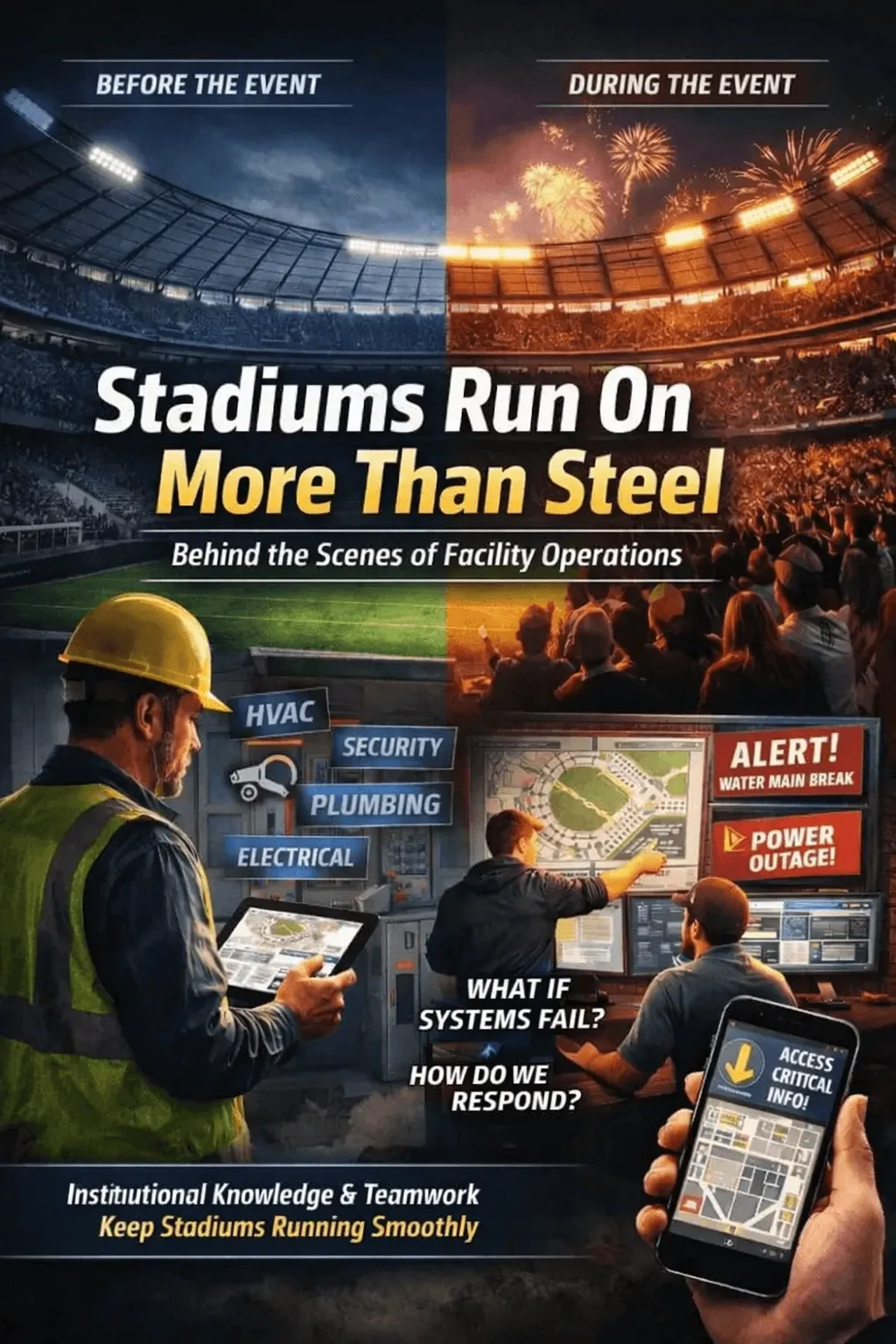
For Event Emergency Preparedness, Clarity Matters More Than Speed
Stadium incidents don’t always start as emergencies. A tripped breaker, an alarm that won’t reset, a temperature complaint in a crowded section—small issues can escalate quickly when the environment is full and visible.
“HVAC affects athlete performance, fan comfort, equipment reliability, and even playing surface conditions. A failure in one area never stays isolated, so preparation means thinking several steps ahead of the problem itself,” Clint added.
In those moments, clarity reduces friction. When technicians, supervisors, and managers can look at the same information, decisions become steadier. There’s less guessing, fewer phone calls, and less reliance on “the one person who knows where all the shut-offs are located.”
This kind of shared understanding also helps across shifts and seasons. Stadiums rely on part-time staff, contractors, and rotating crews. Documentation that’s accessible and grounded in reality helps new people get oriented faster and helps experienced teams stay aligned.
Capturing How a Stadium Actually Operates
Over time, patterns emerge. Certain systems fail under similar conditions. Certain spaces require extra attention during events. Certain procedures evolve because the original design didn’t account for real-world use.
“Each system inside a stadium is interconnected. Power affects lighting, security, broadcast, concessions, and life safety. Water affects restrooms, food service, medical response, and fire protection,” said Clint.
When those lessons are captured instead of forgotten, they start to inform better preventive maintenance, planning, and decision-making. Preventive work becomes more targeted. Capital planning becomes more grounded. Conversations with leadership become more concrete.
The Quiet Work Behind the Noise
Fans experience stadiums at their loudest. Facility teams experience them at their most revealing—before the gates open, after the crowds leave, and in the moments when something doesn’t go as planned.
The work is rarely visible, and it’s rarely simple. It depends on memory, coordination, and judgment built over time.
Capturing that context, and making it available when it matters, doesn’t make the job flashy. It just makes it steadier. And in an environment defined by scale, pressure, and visibility, steady counts for a lot.
In a stadium, there’s no time to hunt for information—especially when tens of thousands of fans are in the building. Mobile access puts critical facility knowledge directly in the hands of the people doing the work, right when and where they need it.
When teams can pull up maps, shutoff locations, and equipment details on their phones, they respond faster, make better decisions, and keep small issues from turning into major disruptions. That kind of immediacy is what keeps events running smoothly and fans focused on the game—not the problems behind the scenes.