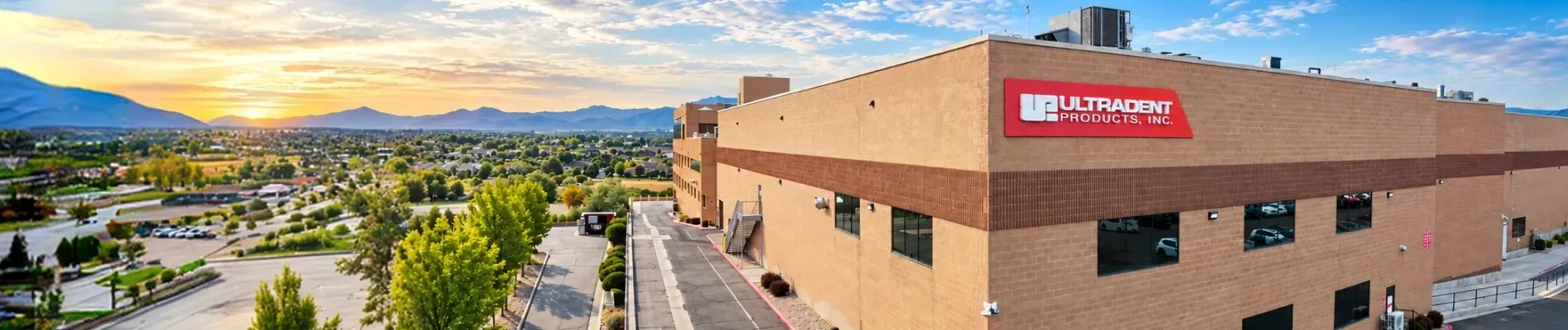
Teamwork & Technology Keep Complex Manufacturing Environment Operating Smoothly
In 1978, Dr. Dan Fischer was practicing dentistry when he saw a problem: the dental products he needed simply weren’t good enough. Getting to the “root” of the problem, he started making his own — literally on the kitchen table with his family.
Today, Ultradent is a global dental-products company with six buildings in South Jordan, Utah, supporting manufacturing, laboratories, offices and product development and nearly a million square feet of facilities.
Behind that operation is a complex facilities environment. Manufacturing depends on compressed air, chilled water, and reliable power, along with controlled environments where temperature, humidity, cleanliness and air changes must meet exact requirements.
If one of those systems goes down, production is impacted.
For Bryan Bingham, Ultradent’s mechanical/HVAC lead, keeping everything running can feel a little like “drinking from a fire hose.”
When Bryan’s team took over responsibility for fire systems from the security department, the documentation was, in his words, “in complete shambles.”
- Very little reliable data
- No updated maps
- Missing documentation
- No centralized system
One building alone had 180 fire extinguishers. During an inspection, 32 were missed.
Leadership wanted contractor accountability. But without accurate locations or current drawings, that was difficult to establish.
Some projects had never been properly documented. Some utilities had been abandoned in place. And institutional knowledge had already walked out the door.
Bryan summed up the risk:
“I’d rather have zero information than incorrect information.”
For a facilities team responsible for emergency systems and a complex manufacturing operation, bad information can be worse than no information.
The documentation problem wasn’t happening in a static environment.
Ultradent’s campus has been under continuous construction for 13 years. Renovations, department moves, renamed projects and system upgrades kept changing the physical environment.
Floor plans could lag behind the building. Equipment locations were sometimes known by references like “old accounting.”
And sometimes, by the time one system was updated, something else had already changed.
The information existed. The challenge was getting it into the hands of the right people when they needed it.
Bryan discovered ARC Facilities at an industry conference and began using it to bring structure to Ultradent’s facility information.
The team started with:
- Emergency equipment mapping
- Fire extinguishers and panels
- Emergency shutoffs
- As-built drawings
Instead of relying on plan rooms, paper records and institutional memory, teams can access building and equipment information from phones and tablets.
Not just Bryan.
Everyone with access can see the same visual information — including technicians working in the field and new team members learning the campus.
When a fire system sends a trouble signal, the team no longer has to start by figuring out where the equipment is.
They can:
- Open ARC Facilities.
- Filter for emergency equipment.
- Locate the specific panel.
- Direct the on-call technician to the right location.
Bryan doesn’t yet track formal response-time metrics, but he’s confident the time required to locate equipment has dropped significantly.
ARC Facilities is also being used for emergency shutoff training and orientation. New team members can get visual context quickly, rather than having to learn the campus one hallway at a time.
In an actual emergency, exact equipment locations can also be shared with responders.
That clarity builds confidence — particularly when the facility itself keeps changing.
Today, Ultradent’s use of ARC Facilities is centered primarily on emergency equipment and drawings. Bryan sees a bigger opportunity, particularly in mapping mechanical systems and connecting equipment information with O&Ms.
Because the deeper issue remains:
Ultradent knows what information it needs. The challenge is making that information organized, current and accessible to the people working in the field.
“Being able to update stuff in the field from a mobile device is a game changer,” said Bryan.
Bryan also sees potential for AI to make facility information even more useful. But the foundation has to come first: clean, structured information that people can access and update in the field.
Ultradent isn’t finished documenting its facilities. Bryan is the first to acknowledge that the work is ongoing.
But the team has made a fundamental shift.
They’re moving from relying on memory to building a shared facility record. From searching for equipment locations to seeing them on a plan. From information that sits somewhere in the organization to information that can be accessed and updated in the field.
In a profession that can feel like drinking from a fire hose, having the right information in front of you makes the flow a little easier to manage.
Ultradent
Ultradent Products has grown from a family operation started by a practicing dentist in 1978 to a global dental products manufacturer with six buildings supporting manufacturing, labs, offices, and product development.